
FenceTrac’s galvanized G90 steel posts are set in concrete the same way wood posts are, but the amount of concrete per post varies based on post size, hole diameter, and hole depth. A standard FenceTrac 2.5-inch residential post in a 10-inch diameter hole at 36 inches deep requires approximately 1.34 cubic feet of concrete, or 2.25 bags of 80-lb premixed concrete, after accounting for a 4-inch compacted gravel base at the bottom of the hole.
Note: this is a general guide only. Installer to verify requirements to comply with local building codes and soil conditions.
The Short Answer
Most residential fence posts need 1.5 to 3.25 bags of 80-lb concrete per post. Larger commercial posts need more. The exact amount depends on three variables: the post cross-section size, the hole diameter, and the hole depth. The tables below give precise bag counts in quarter-bag increments so you can estimate your total purchase accurately.
Cross-Section: How a Fence Post Sits in Concrete
Before looking at the numbers, it helps to understand what the inside of a fence post hole looks like after installation.
 |
|
||||||||||||||||||||||||||||
The post sits centered in a cylindrical hole. A 4-inch layer of compacted gravel sits at the bottom of the hole for drainage. Concrete fills the space between the post and the hole walls, from the top of the gravel to grade level. The concrete locks the post in position and transfers lateral forces (like wind load) into the surrounding soil.
Why a Gravel Base Matters
A 4-inch compacted gravel base at the bottom of the post hole serves two purposes.
First, it provides drainage. Water that enters the hole through the soil or runs down the post has a path to drain away from the base of the post rather than pooling underneath the concrete. Standing water accelerates corrosion on steel and rot on wood, so drainage directly extends the life of the post.
Second, compacted gravel gives the concrete a stable, level surface to cure on. Pouring concrete directly onto loose soil at the bottom of the hole can result in uneven settling as the soil compresses under the weight of the concrete and fence.
All concrete volumes in the tables below account for this 4-inch gravel base. The concrete depth equals the hole depth minus 4 inches.

Concrete Per Post: FenceTrac Steel Posts (80-lb Bags)
FenceTrac recommends a hole diameter of 4 times the post dimension. These are the bag counts for 80-lb premixed concrete bags (approximately 0.6 cubic feet per bag) at each hole depth, rounded up to the nearest quarter bag.
| Post Size | Hole Dia. | 24″ Deep | 30″ Deep | 36″ Deep | 42″ Deep | 48″ Deep |
|---|---|---|---|---|---|---|
| 2.5″ steel | 10″ | 1.5 | 2 | 2.25 | 2.75 | 3.25 |
| 3″ steel | 12″ | 2.25 | 2.75 | 3.25 | 4 | 4.5 |
| 4″ steel | 16″ | 3.75 | 4.75 | 5.75 | 7 | 8 |
The 2.5-inch post is the standard residential size. The 3-inch post is FenceTrac’s standard commercial post. The 4-inch post is used for heavy gate installations and high-load commercial applications. For recommended post spacing, see the FenceTrac installation guide.
Concrete Per Post: Standard Wood Posts (80-lb Bags)
For comparison, here are the bag counts for standard pressure-treated wood fence posts using common hole sizes.
| Post Size | Hole Dia. | 24″ Deep | 30″ Deep | 36″ Deep | 42″ Deep | 48″ Deep |
|---|---|---|---|---|---|---|
| 4×4 (3.5″ actual) | 10″ | 1.5 | 1.75 | 2.25 | 2.5 | 3 |
| 6×6 (5.5″ actual) | 12″ | 1.75 | 2.25 | 2.75 | 3.25 | 3.75 |
Wood posts take slightly less concrete per hole than similarly-sized FenceTrac steel posts because the wood cross-section is larger (displacing more volume inside the hole). The trade-off is that wood posts degrade over time while the powder-coated steel posts do not.
Full Reference: 50-lb Bags
If you are using 50-lb premixed concrete bags (approximately 0.375 cubic feet per bag), use this table instead.
| Post Type | Hole Dia. | 24″ Deep | 30″ Deep | 36″ Deep | 42″ Deep | 48″ Deep |
|---|---|---|---|---|---|---|
| 2.5″ FenceTrac steel | 10″ | 2.25 | 3 | 3.75 | 4.25 | 5 |
| 3″ FenceTrac steel | 12″ | 3.25 | 4.25 | 5.25 | 6.25 | 7.25 |
| 4″ FenceTrac steel | 16″ | 5.75 | 7.5 | 9.25 | 11 | 12.75 |
| 4×4 wood (3.5″) | 10″ | 2.25 | 2.75 | 3.5 | 4 | 4.75 |
| 6×6 wood (5.5″) | 12″ | 2.75 | 3.5 | 4.25 | 5 | 5.75 |
How to Calculate Concrete for Your Entire Fence
Once you know the bags per post, multiply by the number of posts in your fence line.
A typical FenceTrac privacy fence uses posts spaced at 6-foot or 8-foot intervals depending on the panel width. For a 100-foot fence line with 8-foot panel spacing, you need approximately 14 posts (including end and corner posts). At 2.25 bags of 80-lb concrete per post (2.5-inch steel, 36-inch depth), that is 31.5 bags. Round up to 32 whole bags at the store, then add 10% for waste and uneven holes, bringing the total to 35 bags of 80-lb concrete.
Always buy 10% more concrete than the calculation shows. Holes are never perfectly cylindrical, soil conditions vary, and having extra bags on site prevents a mid-project trip to the supply yard.

Fence Design Factors That Affect Hole Depth
The correct hole depth for your project depends on several factors that vary by location and application.
Frost Line
The bottom of the concrete should sit at least 6 inches below the local frost line. In northern states, frost lines can reach 36 to 48 inches or deeper. In southern states, 24 inches may be sufficient. Your local building department publishes frost line depth for your area.
Fence Height
Taller fences generate more wind load, which increases the lateral force on each post. A general guideline is to bury one-third of the total post length. For a 6-foot fence, that means approximately 36 inches of post below grade. For an 8-foot fence, 42 to 48 inches.
Soil Conditions and Wind Exposure
Sandy or loose soil provides less lateral resistance than clay or compacted soil. Properties in high-wind areas or with expansive clay soils may need deeper holes or larger hole diameters. For projects that require stamped engineering documentation, FenceTrac provides site-specific calculations.

Concrete Alternatives: When Posts Are Set on Existing Concrete
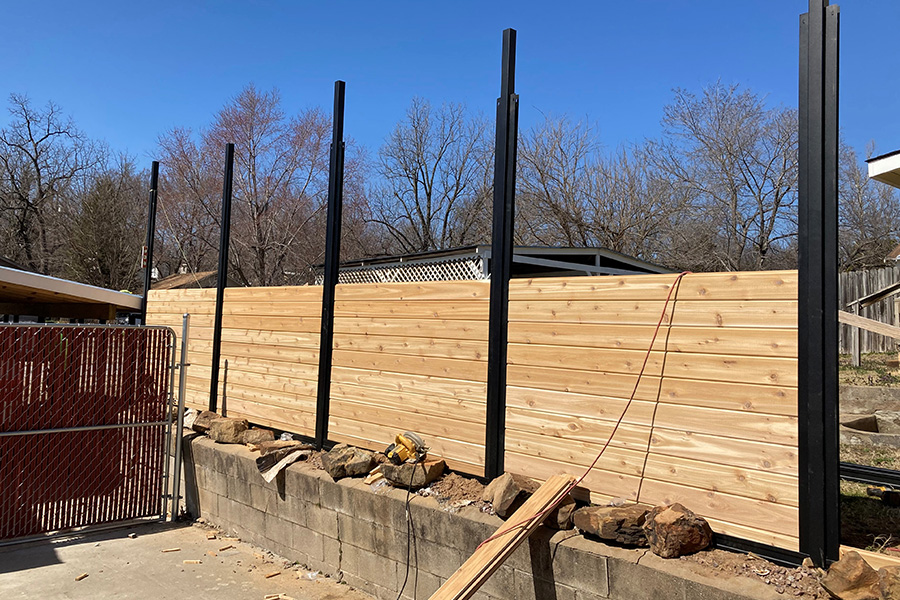
Not every installation involves digging holes and pouring concrete. FenceTrac offers surface-mount base plates that bolt directly to existing concrete surfaces using anchor bolts. This eliminates the need for post holes and concrete entirely.
Surface-mount base plates are common for fences installed on concrete pads, rooftop patios, parking structures, and retaining wall caps. The base plate carries the same structural load as an embedded post when installed with the correct anchor bolts and concrete substrate.
Related Questions
What is the correct spacing for FenceTrac fence posts? FenceTrac posts are typically spaced at 6-foot or 8-foot intervals depending on panel width. Post spacing determines the total number of posts and total concrete needed for the project.
Can you use metal posts with a wood fence? Yes. FenceTrac’s galvanized steel posts accept wood infill boards inside the U-channel frame, giving a wood fence the structural backbone of steel without changing the look.
How do you build a fence that won’t warp or rot? Start with steel posts set in concrete with a gravel base for drainage. The FenceTrac system eliminates the wood posts and rails that cause warping and rot in conventional fences.
See Also
How to build an extremely strong privacy fence for details on FenceTrac’s frame and post engineering. Watch FenceTrac assembly videos for a visual walkthrough of the full installation process.
Get a Quote for Your Fence Project
FenceTrac ships fence systems nationally and has been manufacturing engineered fencing in the USA since 2012.
Every system carries a 20-year warranty and is engineered for long-term performance with minimal maintenance.