
FenceTrac’s galvanized, powder-coated steel fence posts are engineered to maintain their full rated bending strength for the life of the fence, while a standard 4×4 treated Southern Yellow Pine post begins losing structural capacity from the day it goes in the ground. The performance gap between steel and wood is modest at installation. After a decade of moisture cycling, rot, and insect exposure, the gap is not close.
The Short Answer
On day one, a 4×4 treated wood post has more raw bending capacity than a 2-1/2-inch steel post because of its larger cross-section. A 3-inch steel post exceeds wood from the start. But wood posts lose strength every year from ground-line decay, moisture absorption, and fiber degradation.
After 10 years of ground contact, even FenceTrac’s standard 2-1/2-inch residential steel post outperforms what remains of the wood. Steel does not rot, split, or lose bending strength over time.
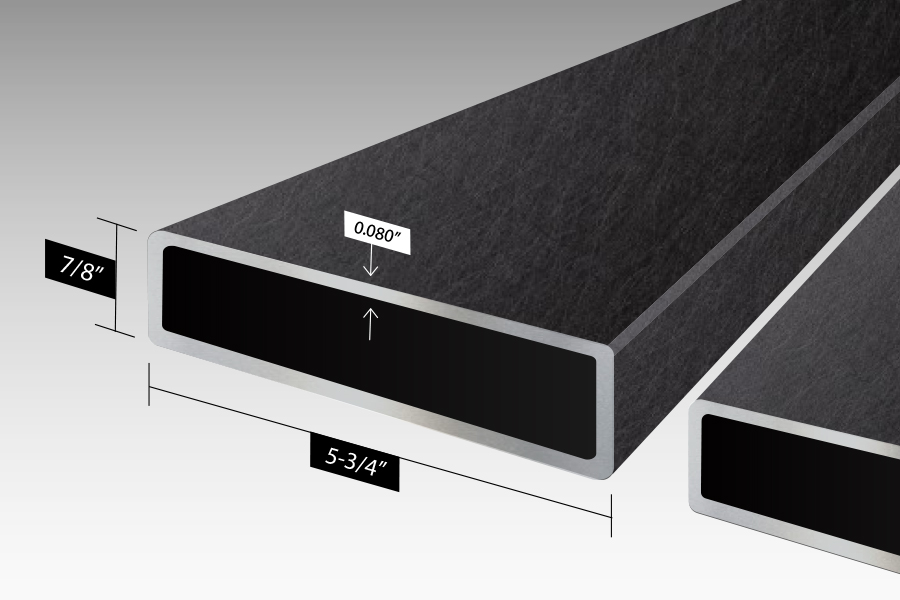
Bending Strength at Installation
The table below compares three post types under a lateral load at 3 feet above grade, the wind load centroid on a 6-foot fence panel. Steel values use a conservative 36,000 psi yield strength. Wood uses the mean in-grade modulus of rupture for No. 2 SYP.
| Specification | 2-1/2″ x 2-1/2″ 14ga Steel | 3″ x 3″ 12ga Steel | 4×4 SYP (3.5″ actual) |
|---|---|---|---|
| Material | Galvanized G90 steel, powder-coated | Galvanized G90 steel, powder-coated | Treated SYP No. 2 |
| Cross-section area | 0.73 in² | 1.21 in² | 12.25 in² |
| Section modulus | 0.57 in³ | 1.13 in³ | 7.15 in³ |
| Failure moment | 1,707 ft-lb | 3,390 ft-lb | 2,989 ft-lb |
| Lateral force at 3 ft | 569 lb (yield) | 1,130 lb (yield) | 996 lb (rupture) |
| Stiffness (EI) | 20.6M lb-in² | 49.2M lb-in² | 20.0M lb-in² |
| At failure, the post… | Bends, stays intact | Bends, stays intact | Snaps, total failure |
The wood post’s advantage comes from its bulk. It has 10 to 17 times more cross-sectional area than the steel options, which compensates for wood’s much lower material strength.
On paper, at installation, the numbers are close. The problem is that cross-section does not stay constant in a wood post.
How Wood Posts Lose Strength Every Year
A wood fence post is biological material buried in soil. It decays. The rate depends on climate, soil moisture, and treatment quality, but the direction is always the same: downward.
Moisture Cycling at the Ground Line
The ground line is where a fence post experiences the highest bending stress and the most aggressive moisture exposure simultaneously. Every rain cycle pushes water into the wood. Every dry period draws it back out.
This repeated cycling creates micro-cracks in the wood fiber that propagate inward over time. Pressure treatment (ACQ or CA-B in most residential posts) slows the process but does not stop it.
The treatment chemicals leach out gradually with each moisture cycle, leaving the wood core increasingly vulnerable to fungal attack.
Cross-Section Loss from Decay
As decay advances, the effective cross-section of the post shrinks. The engineering impact is severe because bending strength depends on the cube of the post width.
A 4×4 post that has lost just 1/4 inch of effective wood on each face from softening and decay is now structurally equivalent to a 3-inch x 3-inch section. That quarter-inch per face costs the post 37% of its original bending capacity.
After 15 to 20 years of ground contact, a half-inch loss per face is common in most climates. The post is now effectively 2.5 inches x 2.5 inches with compromised fiber throughout.
Its bending capacity has dropped below 25% of what it was on day one.
Variability in the Lumber Stack
Wood posts are not manufactured to a strength specification. No. 2 grade SYP allows knots, wane, and natural defects. The weakest 5% of posts in any delivered stack may have barely 60% of the average bending strength before they even go in the ground.
When decay compounds that starting deficit, these posts fail first. Often well before the rest of the fence shows its age.

What the Comparison Looks Like After 10 Years
Steel posts do not degrade. Their bending capacity on year one and year ten is identical. Wood posts in ground contact lose effective cross-section and fiber strength continuously.
A conservative estimate for a 10-year-old treated SYP post in moderate climate assumes 1/4-inch decay per face and 25% fiber strength loss from moisture damage. The same post that started at 996 lb lateral capacity is now closer to 440 lb, less than half its original strength.
At that point, FenceTrac’s standard 2-1/2-inch 14-gauge residential steel post (569 lb yield, unchanged) is 30% stronger than what remains of the wood. The 3-inch commercial steel post (1,130 lb yield, unchanged) is more than double the degraded wood.
In wet climates, coastal environments, or areas with termite pressure, the degradation timeline accelerates. Posts that were adequate at installation can become the weakest structural link in the fence within 5 to 7 years.

Stiffness and Fence Line Straightness
Stiffness measures how much a post deflects under load before reaching its strength limit. A stiffer post keeps the fence line straighter in wind.
FenceTrac’s 3-inch commercial post is 2.5 times stiffer than a 4×4 wood post. The 2-1/2-inch residential post matches the stiffness of the wood post while using only 6% of the cross-section area.
This stiffness advantage shows over time. Steel-framed fence lines hold a straight, consistent profile year after year. Wood fence lines develop the gradual wave pattern that signals aging.
Failure Mode: Bending vs. Snapping
When a steel post is overloaded, it yields. It bends gradually, stays in one piece, and continues supporting the fence panel. There is visible warning before anything structural gives way.
When a wood post is overloaded, it fractures. It snaps at the weakest point, usually at a knot or decay pocket near the ground line. The failure is sudden, with zero warning.
The post goes from functional to broken in an instant, and the fence panel it was supporting drops.
A bent steel post can often be straightened or continues to function. A snapped wood post is removed and replaced, along with the fence section it was holding.
Design Life and Corrosion Protection on Steel
FenceTrac steel posts are galvanized G90 steel with a powder-coated finish. The galvanization provides a sacrificial zinc barrier against corrosion. The powder coat adds a second protective layer and determines the post color (Black, Bronze, White, or Silver).
This two-layer protection system is why FenceTrac backs its posts and frame with a 20-year warranty. The steel underneath does not lose cross-section, absorb moisture, or experience the progressive fiber breakdown that defines wood aging.

A Note on Engineering Values
The comparisons in this post use standard material properties and simplified cantilever beam analysis to illustrate the structural differences between steel and wood fence posts in general terms.
Actual post performance varies with soil conditions, footing design, panel configuration, wind exposure, and local building code requirements. For projects where structural performance is critical, consult a licensed professional engineer for site-specific calculations.

Related Questions
Can you use metal posts with a wood fence? Yes. FenceTrac’s steel posts and channel frame accept wood infill up to 1 inch thick, including Western Red Cedar and treated pine. The steel frame provides permanent structural support while the wood provides the appearance.
Is a steel frame fence more expensive upfront but cheaper long-term? Steel framing costs more at installation. Over 15 to 20 years, the total cost of ownership favors steel because maintenance, post replacement, and fence rebuilds drop to near zero.
See Also
FenceTrac privacy fencing for complete system specifications. Architect specifications for engineering documentation and post details.
Get a Quote for Steel-Post Fencing
FenceTrac ships fence systems nationally and has been manufacturing engineered fencing in the USA since 2012.
Every system carries a 20-year warranty and is engineered for long-term performance with minimal maintenance.