
If your commercial fence keeps blowing down in the same spot, we recommend checking the posts, footings, and connections before replacing another panel.
Wind load travels through 5 linked parts: infill, frame, connections, posts, and footings, so replacing visible damage may leave the cause untouched.
Here’s what we recommend before you approve another repair:
- Find the failure point. Photograph the damage and have a qualified fence professional or engineer inspect the supports, attachments, and gates. Our patented fence system is specifically engineered to address these common failure points.
- Check the replacement design. a steel frame avoids relying on wood for support, but posts, spacing, footings, and infill must still suit your site’s wind loads.
- Count more than repair bills. Track tenant complaints, blocked access, staff time, and safety risks.
- Confirm the scope. Ask for site-specific drawings, a separate gate review, and any required permits or engineering approval.
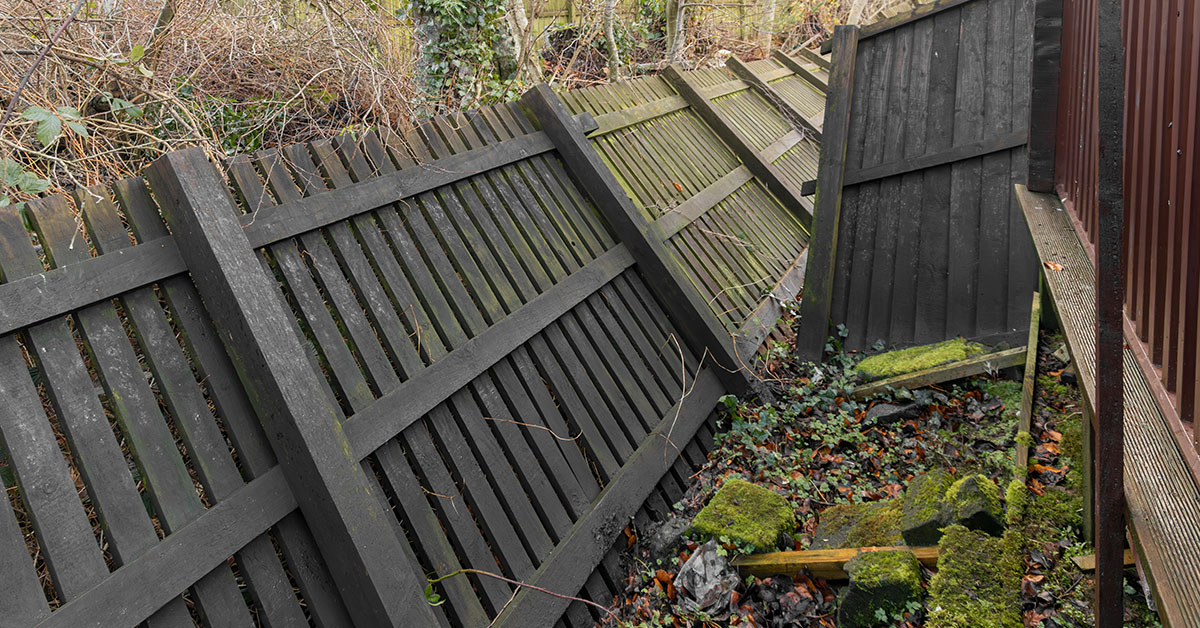
Our goal is simple: fix the cause, not just the damage, with <u>a repair designed for your property</u>.
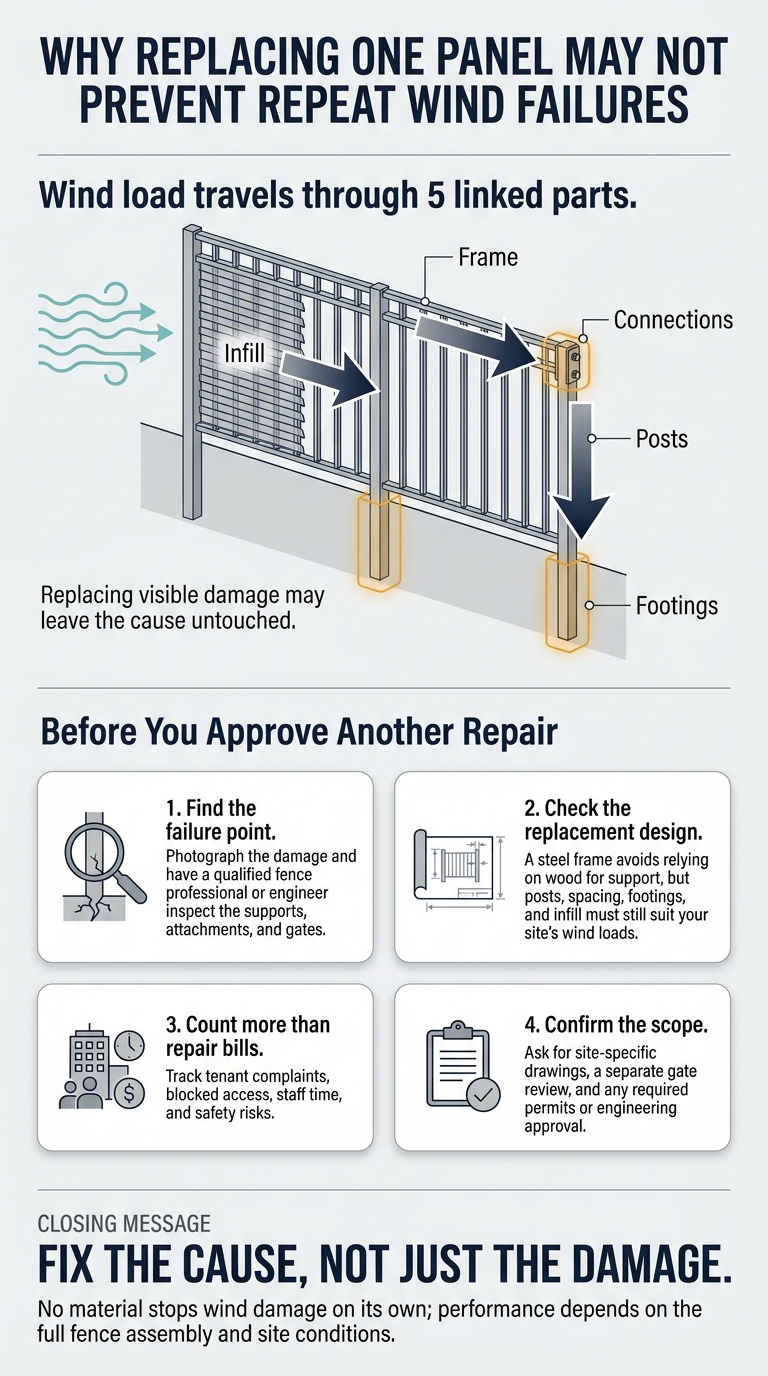
Stop Repeat Fence Wind Damage: Check the Full Support System
Check the Damage Before Ordering Repairs
Before anything is removed, photograph the full fence run, including intact sections, post bases, infill attachments, and gate hardware.
Mark recurring damage on your site plan so the assessor can distinguish a one-time break from a support failure that keeps returning.
Start with the failure pattern, then trace it to the support that moved.
| Symptom | Likely cause | Lasting repair |
|---|---|---|
| Posts snapping or heaving | Deteriorated or inadequate posts, footing movement, or unstable soil (consider durable synthetic fencing material for long-term resilience) | Check posts, footings, soil, and connections, then replace or redesign the support system. |
| Infill blowing out | Failed fasteners, separated rails, or damaged infill attachments | Repair the attachment system and confirm the frame holds the infill in place. |
| Gates racking or sagging | Gate-post movement, damaged hinges, or a shifted gate frame | Fix the source of movement, then realign and test the gate. |
| Sections leaning with intact infill | Post rotation, footing movement, or a weakened section-to-post connection | Repair the failed support or connection, not just the lean. |
These patterns help narrow down the problem, but they don’t replace a site assessment.
A qualified fence professional or engineer should check whether the same support failure affects neighboring sections, especially when multiple posts lean or attachments fail in similar ways.
Before you approve the work, ask for a repair scope that names the cause, not just the broken component.
Fence height, exposure, section width, and infill all affect the load on the fence.
FenceTrac’s guide to wind force on a fence covers the technical figures behind that review.
sbb-itb-908b3eb
Why Wood Posts Fail
In wood-post fences, the weak point is often where the post meets the soil, even if the wood above ground looks sound.
Decay at that spot leaves less solid wood to resist bending under wind load.
Pressure treatment slows decay, but repeated wetting and drying can still loosen the post in its footing, especially when drainage is poor.
Wind makes that looseness worse, and if the footing cannot resist rotation, the post keeps moving.
Straightening the fence won’t restore rotted wood or fix weak support below ground.
FenceTrac’s guide to wood post failures versus steel post strength explains the material differences in detail so you can check whether decay, rotation, or both caused the failure.
The next step is a frame that doesn’t rely on decaying wood for support.
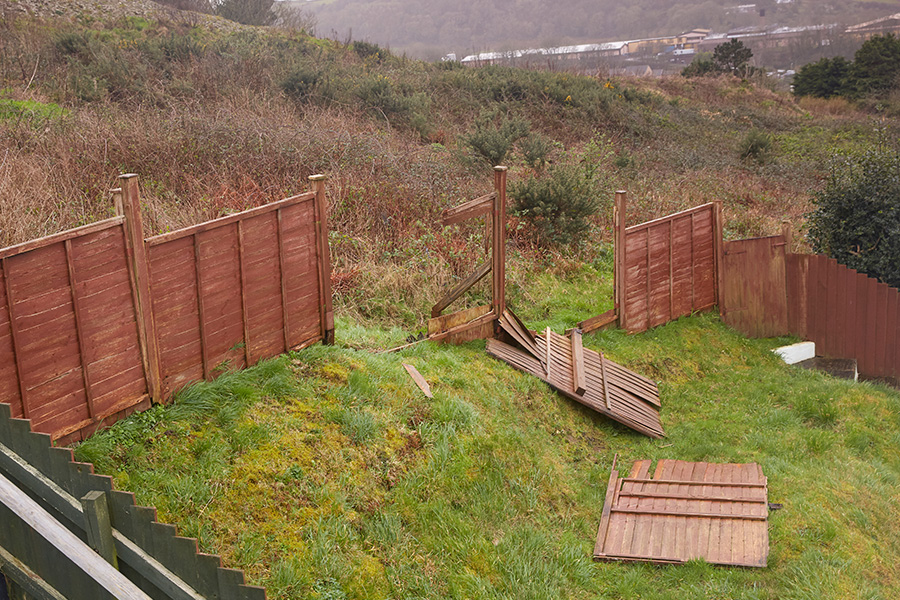 How an Engineered Steel Frame Supports the Fence
The support system matters more than the visible damage, so the fix is a frame that does not rely on wood posts for stiffness.
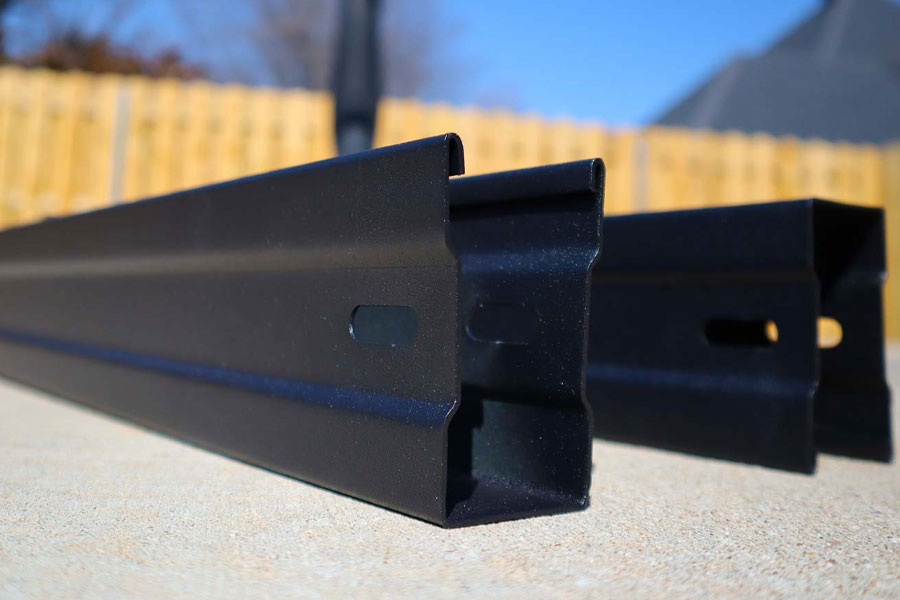
FenceTrac’s patented U-channel powder-coated steel frame holds the infill on all four sides and transfers wind load into the posts. It helps the section keep its shape under wind load, but the supporting posts must address the weak point behind repeat failures.
Side channels fasten to the posts, while bolted connections lock the frame together.
The infill sits inside the frame, giving you a finished look on both sides when both sides of the fence matter. The repair needs to fit your site, not repeat the old failure.
The frame supports several infill types, including LuxeCore, an aluminum-core composite, and UltraBlend PVC. LuxeCore contains no wood, and your infill choice must fit the structural design as well as your privacy and appearance needs.
Posts, frame configuration, spacing, connections, and footings must match your site’s exposure, fence height, and infill.
Before you approve a replacement, ask whether the full fence assembly has been evaluated for those requirements.
Review FenceTrac’s guidance on engineering FenceTrac for wind load and how post spacing affects high-wind fence design with your project team instead of reusing the failed fence’s layout.
No material stops wind damage on its own; performance depends on the full fence assembly and site conditions.
What Repeat Fence Repairs Cost Your Property
When your fence fails again, the cost reaches beyond the invoice into daily property work, access, and liability.
Repeat failures mean more materials, mobilization, inspections, follow-up visits, and staff time to coordinate access, supervise repairs, and notify tenants. Track total property impact, not just the repair bill.
Record disruptions alongside each repair, including blocked pedestrian routes, redirected vehicles, restricted loading access, and interrupted deliveries.
Even a gate that needs a small visible repair can disrupt access control, turning fence damage into a problem for day-to-day property management.
A leaning section or loose infill can create a falling-material risk near walkways, drive lanes, and tenant spaces. An unsecured opening can also expose restricted areas.
Secure the area promptly, and document the affected fence run, nearby gates, and post bases.
Match work orders to tenant complaints. Add each complaint to your site map with its date, exact location, failure type, temporary measure, and completed work.
Repeated complaints about the same gate or boundary show where earlier repairs fixed the appearance without fixing the cause.
Keep dated photographs, inspection notes, invoices, vendor recommendations, and follow-up records together.
Note whether the work temporarily secured the area or corrected the damage, and whether it addressed the cause.
Confirm any legal or code issue with qualified professionals and applicable authorities. Use that record to define the scope of your next repair.

What to Ask for in a Site-Specific Fence Design
To prevent another repeat work order, ask for a design that addresses the failure point, not just the broken part.
Make failure diagnosis part of the design scope, with an inspection of posts, footings, framing, fasteners, infill retention, and gate supports.
Request a site-specific wind-load review that accounts for 5-foot fence height, infill, terrain, exposure, soil conditions, nearby structures, and gate locations to determine why the same spot keeps failing.
Use the commercial fencing wind-load requirements as the design basis rather than treating a generic product claim as proof of performance.
Once you know the cause, ask for drawings that show how the replacement will hold up at your site.
Those drawings should coordinate posts, footings, framing, connections, and gate hardware, including how FenceTrac’s galvanized steel frame holds the chosen infill in its patented U-channel.
Require a separate gate review covering support posts, foundations, hinges, latches, and how the gates latch and stay closed.
Before ordering, confirm permits, property-line restrictions, appearance rules, and any required stamped engineering drawings.
Overlooking these site constraints can undermine the replacement design, so the approved scope should fix the support system, not just replace the infill that blew out.
Use your site measurements, inspection findings, gate requirements, and approval criteria to request a quote through FenceTrac’s Price My Fence tool.
FAQs
Should I repair one section or replace the full fence?
If the same spot in your fence keeps failing, repairing that section may just hide the problem.
Replacing boards won’t fix weak posts, footings, or connections that leave the fence unsupported.
FenceTrac’s galvanized steel frame holds infill on all sides and transfers wind loads to steel posts and engineered footings.
Before you decide, confirm your site’s requirements with your building department or the FenceTrac team.
Can I reuse existing footings with FenceTrac?
Before reusing your existing footings, check with your building department or the FenceTrac team to confirm that the footings, post spacing, and embedment are suitable.
Repeated wind damage often starts with the posts and footings, not the boards.
FenceTrac’s galvanized steel frame distributes wind loads to steel posts and can be engineered for your site’s wind load.
When does my fence repair need an engineer?
If your permit requires engineered documentation, FenceTrac can provide site-specific engineering. Confirm post spacing and embedment with your building department or the FenceTrac team.
Repeated wind failures usually start with posts, footings, or wood-to-rail connections that loosen or rot at ground level.
FenceTrac’s galvanized steel U-channel frame holds the infill and transfers wind loads to steel posts.