
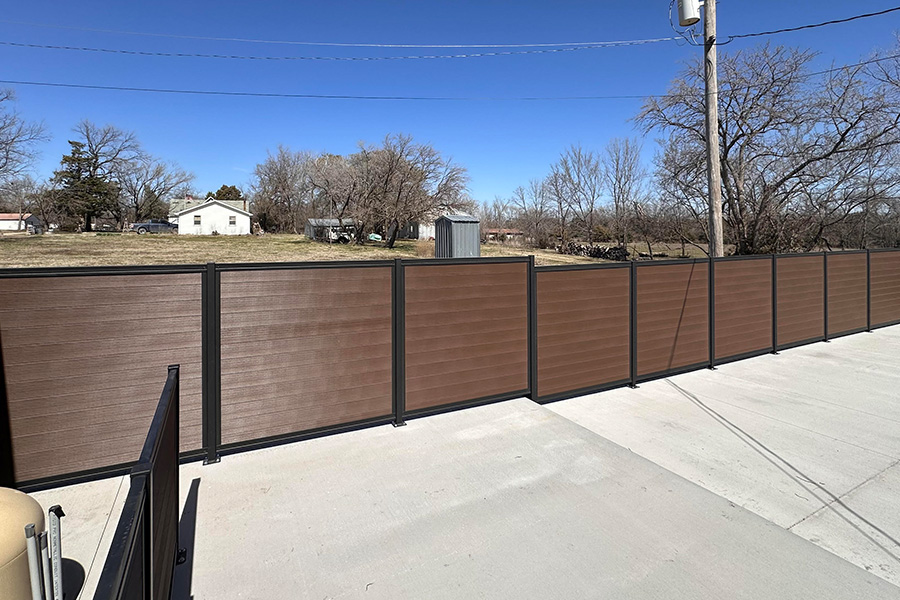
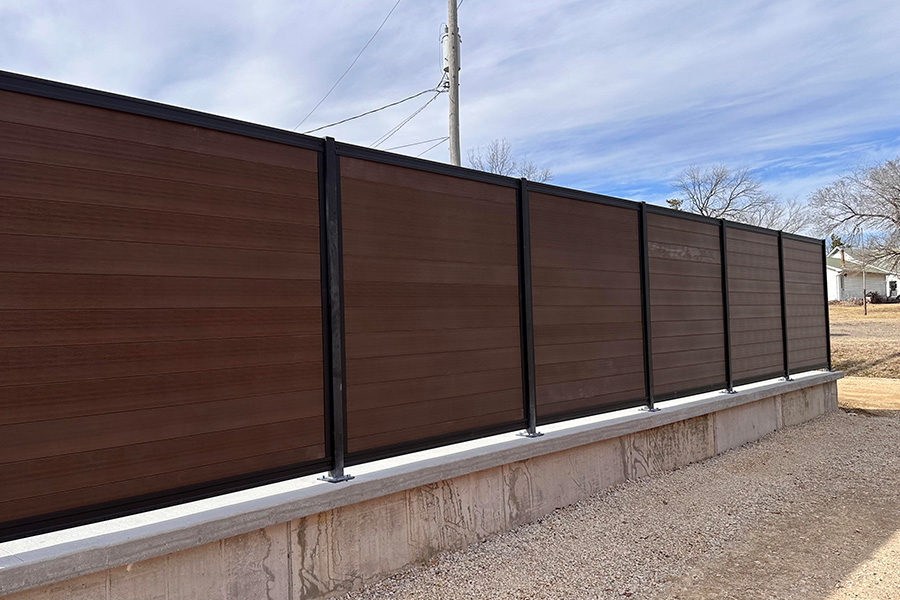
FenceTrac with LuxeCore composite infill has been tested to a design wind load of 55.0 psf (pounds per square foot) under ASTM E330 at QAI Laboratories, which means the system held structural integrity under uniform pressure equivalent to severe wind conditions applied across the full face of a 6-foot panel. A 6-foot privacy fence presents a large surface area to the wind, and the actual force it experiences depends on wind speed, exposure category, panel width, and whether the fence is solid or has gaps that let air pass through.
The Short Answer
Wind force on a fence is measured in pounds per square foot (psf). A 6-foot-tall, 6-foot-wide solid privacy fence panel has 36 square feet of surface area. At 55 psf, that single panel is resisting over 1,900 pounds of total force. Wind pressure increases exponentially with wind speed, so a fence that handles moderate winds comfortably can be overwhelmed quickly as speeds climb. The engineering-tested values of the fence system, not just the materials, determine whether it will stand.
How Wind Creates Force on a Fence
Wind exerts pressure on any surface it cannot pass through. A solid privacy fence acts like a wall. The wind hits the face of the fence, and because it cannot flow through the solid infill, the full energy of the moving air converts to pressure against the panel.
The basic relationship between wind speed and pressure is exponential, not linear. Doubling the wind speed quadruples the pressure. A 60 mph wind produces roughly 9 psf. A 120 mph wind produces roughly 37 psf. A 150 mph wind pushes past 50 psf.
This is why fences that survive everyday winds can fail dramatically in storms. The force increase from 70 mph to 130 mph is not a modest jump. It is a five- to six-fold increase in pressure on every square foot of fence surface.
Wind Pressure at Different Speeds
The table below shows approximate wind pressures using simplified calculations. Actual design pressures depend on exposure category, terrain, and local building codes, but these figures illustrate how quickly force escalates.
| Wind Speed (mph) | Approximate Pressure (psf) | Total Force on 6’x6′ Panel (lbs) |
|---|---|---|
| 60 | ~9 | ~324 |
| 80 | ~16 | ~576 |
| 100 | ~26 | ~936 |
| 120 | ~37 | ~1,332 |
| 140 | ~50 | ~1,800 |
| 150+ | ~55+ | ~1,980+ |
At 150+ mph wind speeds, a single 6-foot by 6-foot fence panel is absorbing nearly one ton of force. That load transfers directly into the posts, footings, and the connections between the frame and the posts.
Where Most Fences Fail Under Wind Load
The fence panel itself is rarely the first thing to break. Failures happen at the weakest structural link in the system.
Post Failure
Wood posts rot at the ground line, reducing their cross-section exactly where the bending stress is highest. A post that was strong when installed can snap at 60 mph winds five years later because decay has reduced its effective diameter. Steel and aluminum posts do not rot, which is why they hold their structural capacity over time.
Fastener Failure
Nails and screws that attach pickets to rails pull through or back out under repeated wind loading. Each gust flexes the fence, and each flex loosens the fasteners. Over time, individual boards pull free and the fence loses structural continuity. FenceTrac’s channel system holds infill without face-nailing, so there are no nail-through-board failure points on the panel.
Footing Failure
Undersized or shallow footings allow the post to rock and eventually lean or pull out of the ground. Wind load on a 6-foot fence creates a strong bending force at the base. A post set 18 inches deep in a small concrete footing will not resist the same wind as a post set 38 inches deep in a properly sized footing.

How FenceTrac Is Engineered for Wind
FenceTrac with LuxeCore composite infill was tested at QAI Laboratories in Miami under ASTM E330 (structural performance under uniform static air pressure) and ASTM E1886 (missile impact and cyclic pressure). The system passed all seven test sequences.
The tested design load was 55.0 psf in both positive and negative directions. Negative load (suction) is what pulls a fence apart from behind during a storm. Many fence systems are never tested for negative load. FenceTrac passed at the same pressure in both directions.
The structural load test reached 82.5 psf (1.5 times the design load per ASTM protocol), and the system held. The large missile impact test fired a 9.25-pound 2×4 at nearly 50 feet per second into the fence three times, with no damage to the sample or fasteners.
These tests were conducted on 3-inch by 3-inch steel posts set in 4,000-psi concrete with proper post spacing and footing depth. The engineering performance depends on the entire system being installed to specification, not just the panel materials.

Design Considerations for High-Wind Fence Projects
If your property is in a high-wind zone, the fence design needs to account for the forces described above. A 6-foot solid privacy fence in an open, exposed location catches more wind than the same fence in a sheltered backyard surrounded by buildings and trees.
Site-specific engineering, including post sizing, footing depth, and post spacing, should be determined by local wind code requirements. FenceTrac offers engineering services for projects that require stamped drawings or wind load compliance documentation.
For coastal properties and hurricane zones, the ASTM E330 and E1886 test data provides the third-party verification that local building officials and engineers need to approve the installation.
Related Questions
How do you build a fence that meets 150 mph wind requirements? The answer starts with an engineered system that has been tested to the pressure loads those wind speeds produce.
Does a semi-privacy fence experience less wind force? Yes. A fence with gaps between boards allows some air to pass through, reducing the effective pressure on the panel. A semi-privacy configuration can reduce wind load by 30 to 50 percent compared to a solid panel, depending on the gap ratio.
See Also
FenceTrac privacy fencing for system specifications and panel size options.
Get a Quote for Wind-Rated Fencing
FenceTrac ships fence systems nationally and has been manufacturing engineered fencing in the USA since 2012.
Every system carries a 20-year warranty and is engineered for long-term performance with minimal maintenance.