
The direct answer is that most traditional wood fences do not have a wind rating. They are built to local convention rather than a tested structural standard, and their ability to handle high wind depends on a set of variables that are rarely engineered in advance.
This distinction matters a great deal for anyone fencing a property in a high-wind area, on the coast, or in a jurisdiction that enforces wind load requirements.

Why Wood Fences Do Not Have a Standard Wind Rating
Most residential fence contractors build wood fences to local convention: post size, post depth, post spacing, and board attachment methods that have worked in their area without formal engineering analysis.
In many jurisdictions, fences under a certain height do not require a building permit. No permit means no engineering review. The fence is designed and installed based on the contractor’s experience and regional norms, not a tested performance standard.
There is no national testing standard that specifies how much wind load a conventional wood fence must withstand. Some local codes define minimum post depth and post size, but very few require third-party testing or a licensed engineer’s stamp for residential fence installations.
This means the wind resistance of a conventional wood fence is not a documented number. It varies from one installation to the next based entirely on how it was built.
The Variables That Determine Wood Fence Wind Resistance
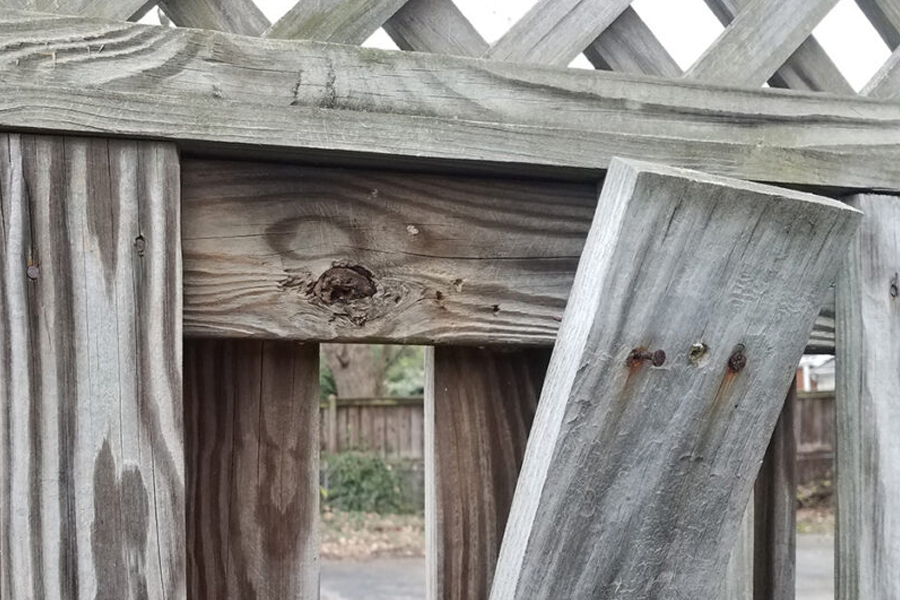
Post size and material matter most. Larger posts with more cross-sectional area resist lateral bending force better than smaller posts. Post material also affects performance over time: wood posts are subject to rot at the ground line, which reduces their structural capacity as the fence ages.
Post depth and footing type are critical. Posts set in concrete with adequate depth resist lateral load much better than posts set directly into soil. Inadequate depth is one of the most common reasons wood fences fail in wind events.
Post spacing affects the structural span. Shorter spans between posts reduce the load on each individual post. Standard residential post spacing of 6 to 8 feet between posts is based on convention, not wind engineering calculation.
Board attachment method determines whether infill stays connected to the frame under load. Face-screwed or ring-shank nailed boards hold significantly better than standard nailed attachment. The connection between infill and frame is often the first point of failure in high wind.
Existing wood condition is an underappreciated variable. A post that was solid at installation may be meaningfully weakened five to ten years later due to ground-level rot, even with pressure treatment.

How Wood Fences Typically Fail in Wind Events
Post failure is the most common failure mode. The post snaps or leans at or near the ground line, where the wood is weakest and often where rot has begun. Once a post goes, the entire fence section between the two adjacent posts comes with it.
Board blowout occurs when individual boards separate from the rails under wind pressure. Boards that were nailed rather than screwed are particularly vulnerable. Loose boards become projectiles in high-wind events.
Rail failure happens when the horizontal rails connecting the posts crack or split under bending load from the boards pushing against them. This often precedes post failure in well-constructed wood fences because the rails reach their limit before the posts do.
Wood Fence vs. Engineered Steel Frame Fence System
| Factor | Traditional Wood Fence | FenceTrac with LuxeCore Composite |
|---|---|---|
| Third-party wind testing | None | ASTM E330: 55.0 psf design load |
| Structural load tested | Not applicable | 82.5 psf (1.5x design load) |
| Missile impact tested | Not applicable | ASTM E1886 Level D (9.25 lb 2×4 at ~50 ft/sec) |
| Post material | Wood (subject to ground rot) | G90 galvanized steel, powder-coated |
| Frame structure | Posts only | Four-sided galvanized steel channel |
| Engineering documentation | Rarely available | Site-specific drawings available |
| Warranty | None standard | 20 years |
| Maintenance required | Yes (periodic) | None |
The FenceTrac test data references the specific configuration tested: LuxeCore composite infill with 3×3 12-gauge steel posts set in 4,000-psi concrete. The full QAI Laboratories test report is publicly available at fencetrac.com.

What Engineered Wind Resistance Looks Like in Practice
An engineered fence system is one that has either been tested to a documented structural standard or analyzed by a licensed engineer to verify performance at a specific design pressure.
The key metric is psf (pounds per square foot of wind pressure) rather than mph. Design pressure in psf accounts for the actual force the wind exerts against the fence surface, factoring in height, exposure, and local topography. It is a more accurate basis for structural evaluation than a wind speed estimate.
FenceTrac with LuxeCore composite infill was tested under ASTM E330 at QAI Laboratories and passed at a design load of 55.0 psf and a structural load of 82.5 psf, in both positive (push) and negative (suction) directions. It also passed ASTM E1886 Large Missile Impact Level D: three separate impacts from a 9.25-pound 2×4 at approximately 50 feet per second, with no damage to the sample or fasteners.
For installations where local code requires a stamped engineering drawing, site-specific calculations from a licensed Engineer of Record are available for FenceTrac projects.

If You Are Fencing a High-Wind Property
In designated wind zones, coastal areas, and hurricane regions, a conventional wood fence is unlikely to meet local design pressure requirements. These installations can and do fail in major wind events, not because they were poorly built, but because they were never designed for the structural demands of their environment.
The right question for a high-wind application is not how much wind a fence might survive. It is whether the fence has been tested and documented to meet the design loads required by local code.
For more detail on how FenceTrac fence systems are specified for wind load compliance, see can FenceTrac fence systems be engineered for wind load requirements.
Get a Quote for a Wind-Resistant Fence
FenceTrac ships fence systems nationally and has been supplying contractors, property owners, and commercial buyers since 2012.
Every system carries a 20-year warranty and is engineered for long-term performance with minimal maintenance.