
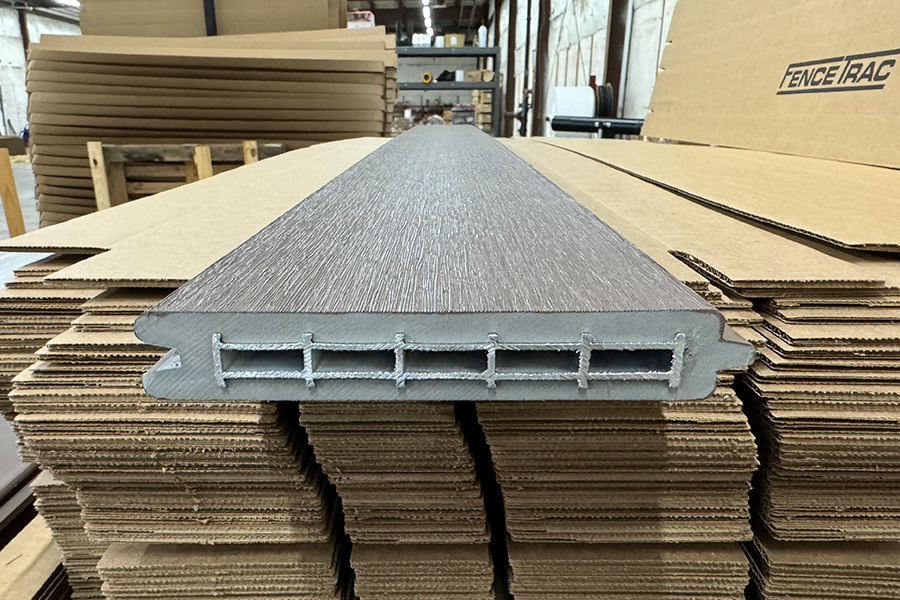
FenceTrac’s LuxeCore aluminum-core composite fence boards are built around a structural aluminum core encased in cellular PVC and ASA resin, with zero wood content. Wood fiber composite (WPC) boards blend wood flour or fiber with thermoplastic polymer, typically polyethylene or polypropylene.
The material at the center of each board determines how it performs over 5, 10, and 20 years of outdoor exposure.
The Short Answer
The defining difference is what is inside the board. LuxeCore has an aluminum structural core. WPC has wood fiber.
Aluminum does not absorb moisture, support mold, or lose rigidity in heat. Wood fiber does all three.
These are not two versions of the same product. They are two fundamentally different material categories with different internal structures, different failure mechanisms, and different performance ceilings.
Material Comparison
The table below compares the two material categories on the factors that determine how a fence board performs over the life of the fence.
| Factor | Aluminum-Core Composite (LuxeCore) | Wood Fiber Composite (WPC) |
|---|---|---|
| Core material | Structural extruded aluminum | Wood fiber blended with plastic |
| Wood content | Zero | 30-60% by weight |
| Moisture absorption | None | Yes, through exposed wood fibers |
| Mold/mildew risk | None (no biological material) | Susceptible, especially in humid climates |
| Warping/cupping | Resistant (aluminum core holds shape) | Common as wood fibers absorb moisture |
| Thermal sag | Resistant (aluminum core maintains rigidity) | Can soften and sag in sustained high heat |
| Impact resistance | High (aluminum backbone absorbs force) | Moderate (no structural core) |
| Board thickness | 1″ tongue and groove | Typically 1/2″ to 3/4″ |
| UV protection | ASA resin shell (automotive-grade) | Polyethylene cap (varies by manufacturer) |
| Warranty | Limited Lifetime Warranty | Varies; typically 10-25 years |
Why Wood Fiber Creates Problems Over Time
Wood fiber is the structural filler in every WPC board. It adds bulk, stiffness, and reduces raw material cost compared to an all-polymer board. But wood fiber is also the source of nearly every long-term performance issue WPC fence boards experience.
Moisture Absorption and Warping
Wood fiber absorbs water, even when encapsulated in plastic. Wherever a board is cut, drilled, scratched, or where the cap layer thins at edges and corners, moisture finds a path to the wood fiber inside.
Once moisture enters the core, the wood fibers swell. This swelling is uneven, which causes the board to warp, cup, or bow.
In a fence panel, warped boards create a wavy surface that worsens with each wet/dry season. The damage is cumulative and irreversible without replacing the affected boards.
Mold and Mildew Growth
Wood fiber is an organic material. In humid or shaded environments, the moisture trapped inside a WPC board creates conditions that support mold and mildew growth.
Surface mold appears as dark streaks or patches. Internal mold breaks down the wood fiber structure over time, weakening the board from the inside.
Thermal Sag and Deformation
WPC boards soften in sustained high heat because the thermoplastic binder loses rigidity as temperature rises. Without a structural core to maintain shape, a WPC board can sag between support points on hot days.
In fencing applications where boards span the full width of a panel, this thermal movement is visible as a bowed or drooping surface during summer months.
LuxeCore’s aluminum core acts as a structural spine that holds the board’s shape regardless of temperature. Aluminum maintains its rigidity well beyond any outdoor temperature a fence will experience.

Structural Performance Under Load
The most significant performance gap between the two categories shows up under wind load and impact testing.
FenceTrac’s system with LuxeCore aluminum-core composite infill was tested at QAI Laboratories to 55.0 psf design wind load and 82.5 psf structural load under ASTM E330. The same system passed Large Missile Impact Level D under ASTM E1886, absorbing three impacts from a 9.25 lb 2×4 lumber missile at nearly 50 feet per second with no damage to the boards or fasteners.
No wood fiber composite fence product has published comparable third-party wind load or impact test results. The aluminum core inside each LuxeCore board is a primary reason the system held structural integrity through all tests. A WPC board of the same dimensions, without a metal core, would not distribute impact energy the same way.
Design and Installation Differences
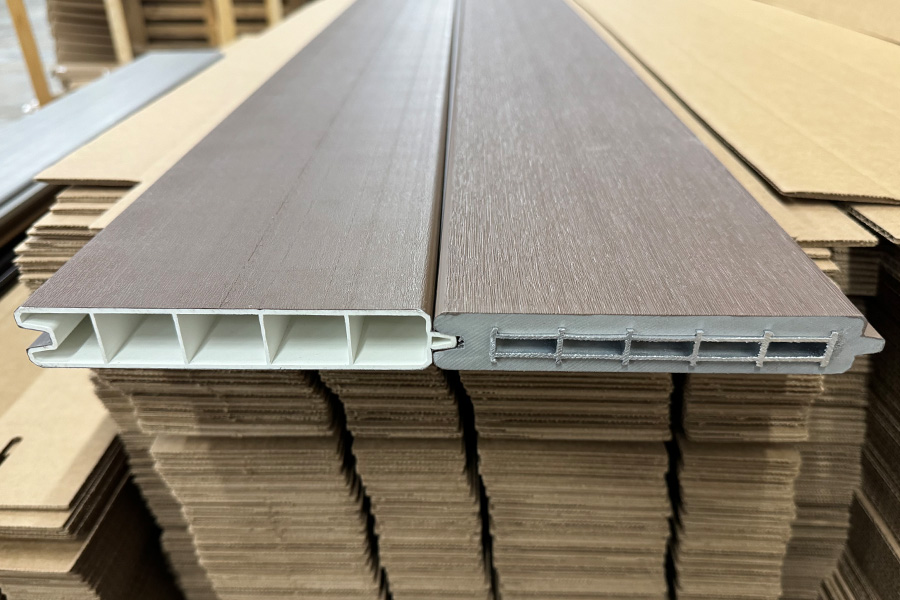
LuxeCore boards are 1 inch thick, which seats them securely in the FenceTrac channel frame system. Most WPC fence boards are 1/2 inch to 3/4 inch thick. The thicker profile gives LuxeCore more edge contact inside the channel, which improves wind load transfer and reduces board movement within the frame.
Both material types are available in wood-grain textures and multiple colors. Both are marketed as low-maintenance. The difference is that LuxeCore’s zero-wood, aluminum-core construction delivers that low-maintenance promise without the degradation mechanisms that wood fiber introduces beneath the surface.

Related Questions
What are aluminum-core composite fence boards? A full breakdown of the three-layer construction: aluminum structural core, cellular PVC body, and ASA resin shell. Covers specifications, design options, and what makes this a new material category.
What is the most low-maintenance fence material? Maintenance requirements depend on the materials used. Aluminum-core composite and PVC infill options both deliver zero-maintenance performance. Wood-based composites may require periodic cleaning to address mold and surface staining.
See Also
LuxeCore aluminum-core composite fencing for product details and color options. Best fence systems for coastal environments for applications where moisture resistance is critical.
Get a Quote for Aluminum-Core Composite Fencing
FenceTrac ships fence systems nationally and has been manufacturing engineered fencing in the USA since 2012.
Every system carries a 20-year warranty and is engineered for long-term performance with minimal maintenance.