
FenceTrac’s galvanized steel frame system is engineered to resist the most common causes of fence failure in high winds, including post rotation, fastener pullout, infill separation, and ground-line rot. The system was tested to 55.0 psf design wind load and 82.5 psf structural load under ASTM E330 at QAI Laboratories with no damage to the sample or fasteners.
The Short Answer
Fences fail in high winds because of weak connections, not just weak materials. The post-to-ground connection, the rail-to-post connection, and the infill-to-rail connection are the three points where most wind damage begins. When any one of those connections gives way, the rest of the fence follows.
A fence that uses stronger materials at each connection point and distributes wind load across a rigid frame will outperform a fence built with the same infill but weaker structural joints.
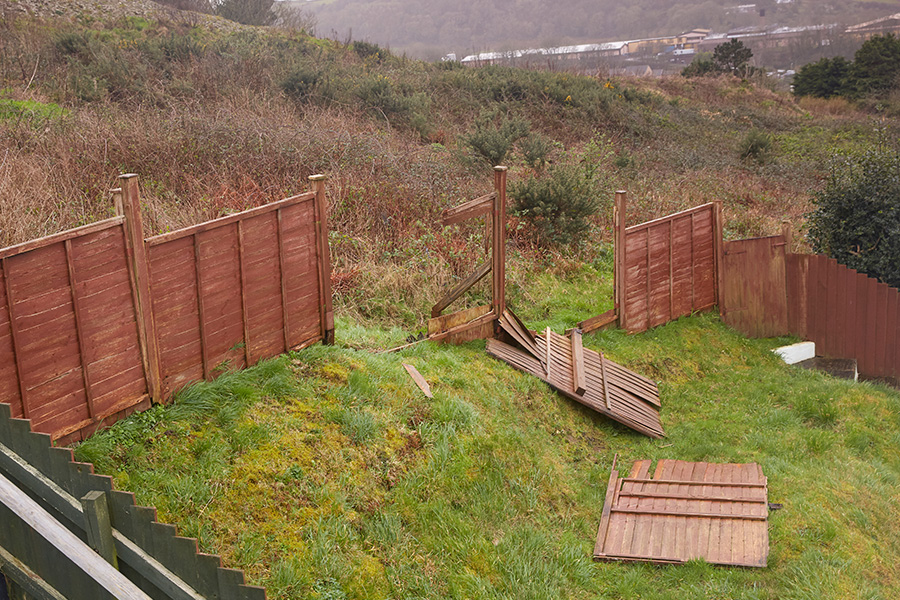
The Five Most Common Fence Failure Modes in Wind
Wind does not usually snap fence boards in half. It exploits the weakest connection in the system and works outward from there. These are the failure modes ranked by how frequently they occur.
Post Rotation and Lean
This is the most common failure. Wind pushes the fence panel laterally, transferring force into the posts. If the post footing is too shallow, too narrow, or set in loose soil, the post rotates in the ground. Once a post leans even a few degrees, the panel it supports is compromised.
Wood posts are especially vulnerable because they lose grip in the footing over time. Moisture cycles cause the wood to swell and shrink, which loosens the bond between the post and the concrete. After a few years, a wood post may already be loose before a major wind event hits.
FenceTrac’s steel posts do not swell or shrink. The powder-coated galvanized steel maintains a consistent profile in the footing, so the concrete bond stays tight for the life of the fence.
Fastener Pullout
Nails and screws driven into wood rails pull out under repeated wind loading. Each gust applies force, loosens the fastener slightly, and the next gust loosens it more. This is called cyclic fatigue, and it accelerates in wind events that last hours.
FenceTrac uses self-tapping screws into galvanized steel for post-to-channel connections and carriage bolts for channel-to-channel joints. Steel-to-steel fastening does not loosen under cyclic loading the way steel-to-wood does.
Rail Separation from Posts
In traditional wood fences, horizontal rails are face-nailed or toe-nailed to the post. That connection relies entirely on the holding power of nails in end grain, which is the weakest possible wood-to-nail joint. High winds pull the rail away from the post, and the fence boards attached to that rail go with it.
The FenceTrac frame eliminates this failure mode. The vertical side channels attach directly to the post with self-tapping screws through the channel face, and the horizontal channels bolt to the side channels with carriage bolts. There is no end-grain nailing anywhere in the system.

Infill Board Separation
Fence boards nailed to rails can pop free when wind creates positive pressure on one side and suction on the other. The alternating push-pull force works nails out of the rail, and individual boards peel away from the fence.
FenceTrac’s U-channel design holds infill boards in a continuous track. The boards are captured on all four sides by the steel frame channels. They cannot pop free because they are not fastened with nails or screws. They are held in place by the frame itself, which is the same principle used in commercial curtain wall and storefront glazing systems.
Ground-Line Rot
Wood posts rot at the ground line where moisture concentrates. A post that looks solid above grade may be structurally compromised at the most critical point: where it transfers lateral load into the footing. Ground-line rot turns a wind resistance problem into a structural failure that can happen without warning during a storm.
Steel posts do not rot. FenceTrac posts are G90 galvanized steel with a powder-coated finish, embedded in concrete footings. The steel-to-concrete interface does not degrade over time.

Ideas for Building a Wind-Resistant Fence
If you are in a high-wind zone or an area with hurricane exposure, four factors determine how well your fence will hold up.
First, post material and sizing. Steel posts outperform wood in every wind scenario. Larger posts (3-inch or 4-inch) handle higher loads.
Second, footing depth and diameter. Deeper, wider footings resist post rotation. Local building codes specify minimums, but high-wind areas often require engineered footings beyond code minimums.
Third, the connection system. Bolted and screwed steel-to-steel connections hold under cyclic wind loading. Nailed wood-to-wood connections do not.
Fourth, panel width. Narrower panels (6-foot vs. 8-foot) reduce the wind load on each post. FenceTrac offers both widths, and engineering support is available for projects that require site-specific wind load calculations.

Related Questions
Can a privacy fence survive a hurricane? A steel-framed privacy fence with engineered footings and tested wind load ratings has a far better chance than a wood fence. FenceTrac’s system passed Large Missile Impact Level D under ASTM E1886, which simulates hurricane-level debris.
What wind speed will knock down a wood fence? Most wood fences begin to fail at sustained winds of 50 to 70 mph, depending on the age of the fence, post condition, and soil type. FenceTrac’s system was tested to 82.5 psf structural load, which corresponds to significantly higher wind speeds.
For detailed test data and full engineering specifications, visit the FenceTrac specifications page.
See Also
LuxeCore composite fencing, the infill product tested alongside the FenceTrac frame in the QAI wind load and missile impact tests.
Get a Quote for a Wind-Resistant Fence
FenceTrac ships fence systems nationally and has been supplying contractors, property owners, and commercial buyers since 2012.
Every system carries a 20-year warranty and is engineered for long-term performance with minimal maintenance.