
The difference between a privacy fence and a semi-privacy fence comes down to one thing: how much you can see through it.
A privacy fence is a solid barrier. No gaps, no sightlines, no visibility from either side. A semi-privacy fence has intentional spacing between the boards that allows some airflow, light, and partial visibility through the fence.

Both serve legitimate purposes. The right choice depends on what you need the fence to do.
What a Privacy Fence Does
A privacy fence creates complete visual screening between your property and whatever is on the other side. Neighbors, streets, commercial properties, parking lots. If you cannot see through the fence, it is a privacy fence.
Privacy fencing is the most common choice for residential backyards, pool enclosures, and commercial screening applications where the goal is to block the view entirely.
The standard height for a privacy fence is 6 feet, which blocks sightlines for most people standing at ground level. Some applications call for 8-foot privacy fencing, particularly in commercial settings, around pool equipment, or where the adjacent property sits at a higher elevation.
FenceTrac builds privacy fencing using a galvanized G90 steel frame with solid infill boards that fit into the frame channels with no gaps between them. The tongue-and-groove connection between boards eliminates any visible space. From the outside, the fence reads as a continuous solid surface.
What a Semi-Privacy Fence Does
A semi-privacy fence provides partial screening. You can see shapes and movement through the fence, but not fine detail. The level of visibility depends on the gap size between boards and the viewing angle.
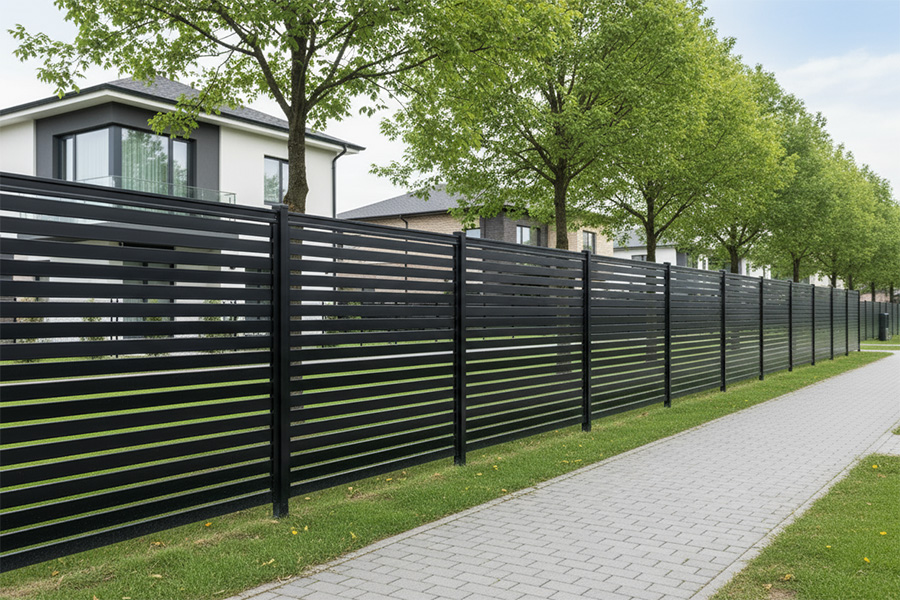
Semi-privacy fencing is the right choice when you want to define a boundary and reduce visibility without creating a solid wall. Common applications include front yards, side yards facing streets, commercial properties where you want some street presence, pool areas where code requires a barrier but full privacy is not the goal, and anywhere airflow through the fence matters.
Wind load is a practical reason to consider semi-privacy over full privacy. A solid privacy fence catches wind like a sail, while a semi-privacy fence lets wind pass through the gaps.
That difference significantly reduces the structural load on the posts and footings. In high-wind areas, semi-privacy fencing can be the more practical engineering choice.
How FenceTrac Builds Privacy Fencing
The FenceTrac privacy fence system starts with the galvanized steel frame. The frame’s channel rails hold the infill boards on all four sides, so there are no unsupported spans where boards can shift, warp, or separate over time.

For full privacy, the infill boards are installed with tongue-and-groove connections that lock together inside the frame. No light passes through. No gaps develop as materials expand and contract with temperature changes, because the steel frame holds everything in position.
Infill options for privacy fencing include LuxeCore composite boards (aluminum core, cellular PVC, ASA coating, four colors), UltraBlend PVC boards (solid PVC with ASA coating, same four colors), and aluminum tongue-and-groove boards.
All three options produce a true privacy fence with zero visibility through the fence line.
How FenceTrac Builds Semi-Privacy Fencing
The FenceTrac semi-privacy fence system uses the same galvanized steel frame as the privacy system. The difference is in the infill configuration.
Semi-privacy fencing uses aluminum slat boards with spacers between them. The spacers control the gap between each board. FenceTrac supplies spacers starting at 3/4″ with stackable spacers in 1″ increments.
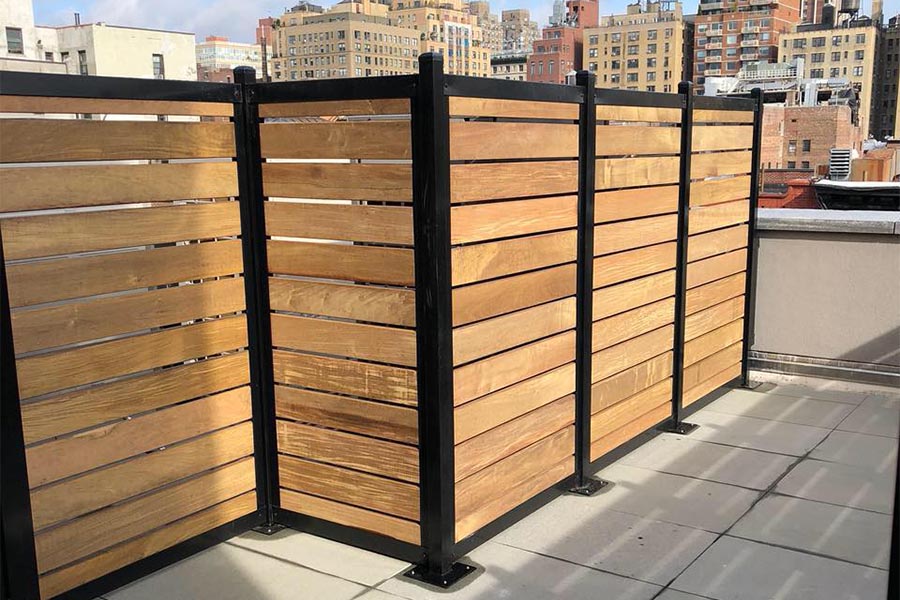
This means you can fine-tune the gap to match your exact requirements. A 3/4″ gap provides substantial screening with minimal visibility through the fence. A 2″ or 3″ gap opens the fence up significantly and creates the horizontal slat look that is popular in modern residential and commercial design.
The aluminum slat boards come in Black, White, Silver, and Bronze powder-coat finishes. The boards are 6063-T5 aluminum, which means they will not rust, rot, warp, or require repainting.
Privacy Fence vs. Semi-Privacy Fence: Key Differences
Visibility is the obvious difference, but there are several other factors worth considering.
| Factor | Privacy Fence | Semi-Privacy Fence |
|---|---|---|
| Visibility | Zero sightlines through the fence | Partial visibility depending on gap size |
| Airflow | Blocks wind and air movement | Allows airflow through gaps between boards |
| Wind load | Full wind force against solid surface | Reduced load as wind passes through gaps |
| Light | Blocks sunlight, creates shade | Filtered light passes through spacing |
| Best for | Backyards, pool enclosures, screening | Front yards, streetscape, modern design |
Cost is similar for both configurations when using the FenceTrac system, because the steel frame and posts are identical. The difference is only in the infill boards and spacers.
Code requirements matter in some jurisdictions. Pool enclosures, for example, often have specific requirements about fence height and whether gaps are permitted. Check your local building code and HOA guidelines before committing to either style.
Can You Mix Privacy and Semi-Privacy on the Same Property?
Yes. This is one of the advantages of the FenceTrac modular system.
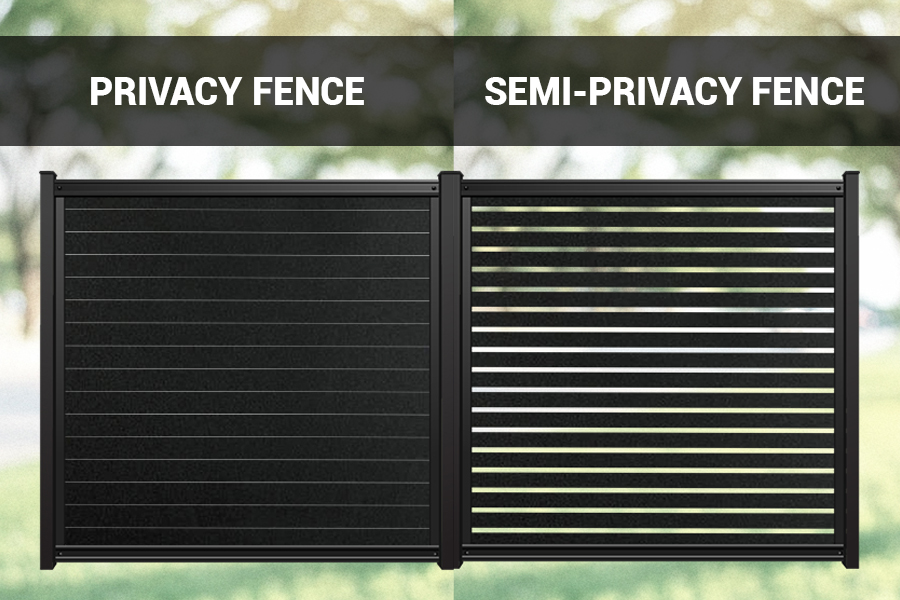
A common approach is to use full privacy fencing along the back property line and the sides adjacent to neighbors, then switch to semi-privacy fencing along the front or along a side that faces a view you want to preserve.
Because both configurations use the same steel frame and post system, the transition between privacy and semi-privacy sections is seamless. The frame dimensions and post spacing are identical. Only the infill changes.
Mixing fence styles also lets you manage wind load strategically. If one side of your property faces prevailing winds, semi-privacy on that side reduces the structural demand while the other sides remain fully private.
Which One Should You Choose?
Choose privacy fencing if your primary goal is to block all visibility. Backyards, pool enclosures, commercial dumpster screening, and any application where you need a complete visual barrier.
Choose semi-privacy fencing if you want boundary definition with controlled airflow, reduced wind load, and a more modern aesthetic. Front yards, side yards, commercial street-facing boundaries, and any application where the horizontal slat look supports the design intent.
If you are not sure, the FenceTrac pricing tool lets you configure both options and compare.
Get a Quote for Privacy or Semi-Privacy Fencing
FenceTrac ships fence systems nationally and has been supplying homeowners, contractors, and commercial buyers since 2012.
Every system carries a 20-year warranty and is engineered for long-term performance with minimal maintenance.