
Semi-privacy fencing screens a space without completely closing it off. The challenge is choosing the right style for how you want to manage sightlines, airflow, and appearance on your specific property.
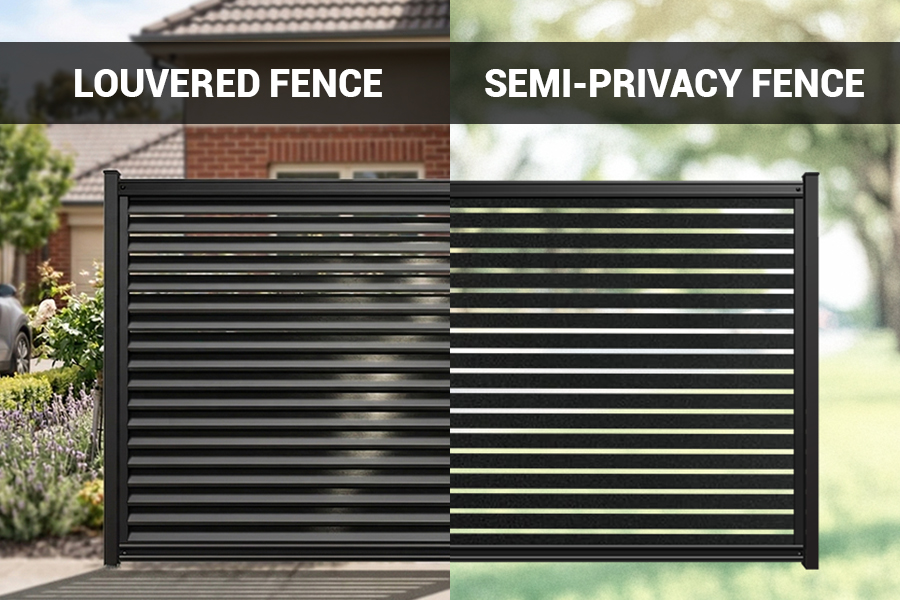
Louvered and spaced picket are the two most common traditional approaches to semi-privacy fencing. They solve the problem differently, and the difference goes well beyond aesthetics.
How Semi-Privacy Fencing Handles Sightlines
Semi-privacy fencing uses intentional gaps in the infill to let light and air through while still creating a visual boundary. How well it blocks sightlines depends on the orientation of the boards, the width of the gaps, and where someone is standing relative to the fence.
Louvered and spaced picket fencing both create gaps in the fence line. The critical difference is what the viewer encounters when looking through those gaps.
What Is Louvered Fencing?
Louvered fencing uses boards installed at an angle rather than flat against the frame. The angle typically runs between 30 and 45 degrees, similar to the louvers on a window shutter or an HVAC vent.
The angled position is what creates the sightline block. Someone looking through the fence from most viewing positions sees the face of a tilted board rather than the gap behind it. The gap exists, but the board’s angle redirects the line of sight.

This is why louvered fencing blocks sightlines more effectively than a flat-board design with the same gap width. The angle does the work that gap width cannot.
The tradeoff is complexity. Louvered fencing requires angled mounting hardware or custom carpentry to hold every board at a consistent angle. Construction is more involved than other semi-privacy styles, and the cost reflects that.
Most louvered fencing is built with wood, which means ongoing maintenance including painting, sealing, and eventual board replacement as the wood weathers. The angled profile also makes individual board repairs harder than on a standard flat-board fence.
What Is Spaced Picket Fencing?
Spaced picket fencing uses flat boards installed upright with consistent gaps between them. The boards are parallel to each other, and the gaps are open and direct.
From a straight-on viewing angle, the gaps in spaced picket fencing are fully visible. Privacy depends entirely on the width of the gaps. Smaller gaps provide more screening. Larger gaps create an open boundary with minimal blocking.

Traditional residential picket fencing is the most recognizable version of this style. For semi-privacy applications, boards are typically wider with narrower gaps, but even tight gaps leave a direct sightline through the fence at certain viewing angles.
Spaced picket is simpler to build than louvered fencing and generally less expensive. It works well for properties where a visual boundary with some openness is the goal, rather than strong sightline elimination.
How Louvered and Spaced Picket Fencing Compare
| Feature | Louvered | Spaced Picket |
|---|---|---|
| Board orientation | Angled (30–45°) | Vertical, flat |
| Sightline blocking | High | Moderate |
| Airflow | Good | Good to excellent |
| Appearance | Traditional / architectural | Traditional residential |
| Construction complexity | Higher | Lower |
| Adjustable spacing | Not typical | Limited |
| Maintenance required | Yes (wood) | Yes (wood) |
The right choice depends on how much sightline control you need and how much you want to invest in installation and maintenance. Louvered fencing does more work on privacy at a higher build cost. Spaced picket is more economical but provides less actual screening.
A Modern Alternative: Horizontal Semi-Privacy Fencing
Both louvered and spaced picket fencing use vertical boards. A third approach, horizontal semi-privacy fencing, has become popular because it changes both the visual character and the performance profile of the fence entirely.
FenceTrac’s semi-privacy fencing uses aluminum infill boards installed horizontally inside a galvanized G90 steel frame. The boards are flat, not angled, so sightlines function similarly to spaced picket fencing. But the horizontal orientation gives the fence a clean, contemporary look that pairs naturally with modern architecture and commercial environments.
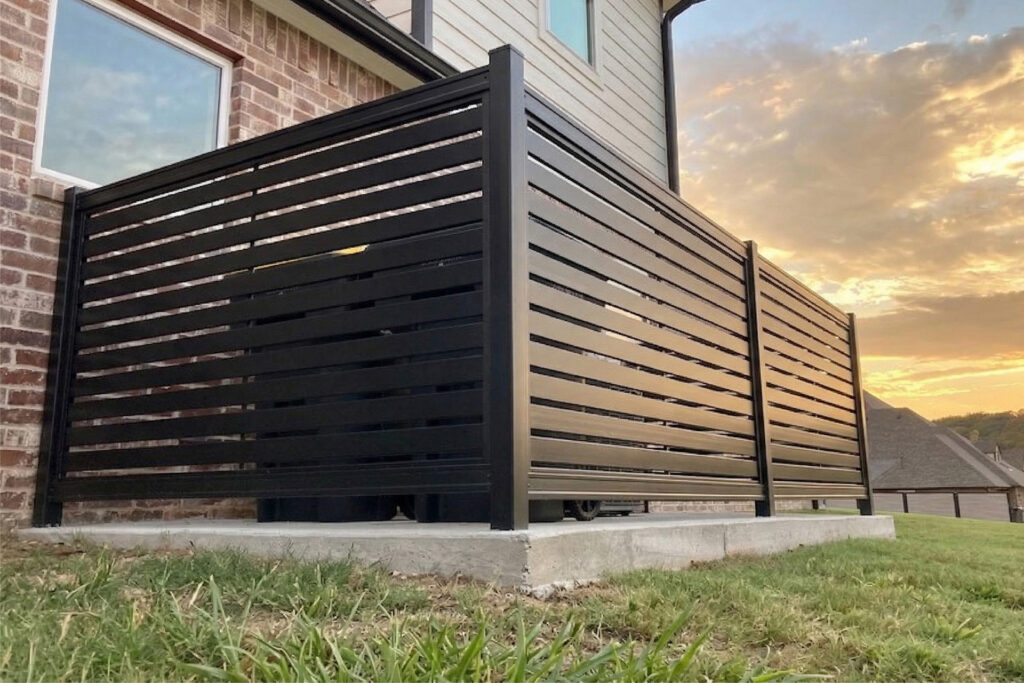
FenceTrac supplies stackable spacers starting at 3/4 inch to control the gap between boards. Wider gaps allow more light and airflow. Tighter gaps improve screening. The level of openness can be configured to match the requirements of the project.
Because the infill is aluminum and the frame is galvanized steel, there is no wood to rot, warp, or repaint. The system carries a 20-year warranty and is available in 4-foot, 6-foot, and 8-foot heights.
FenceTrac semi-privacy suits residential yards, pool environments, outdoor dining areas, resort properties, walkways, and commercial projects where durability and appearance both matter.
Which Semi-Privacy Style Fits Your Project?
Louvered fencing is the right choice when eliminating sightlines from a specific direction is the top priority and budget allows for more complex installation. It performs best on high-end residential projects where privacy control is the primary design requirement.
Spaced picket fencing works for traditional residential applications where a light visual boundary is sufficient and installation cost is the primary consideration.
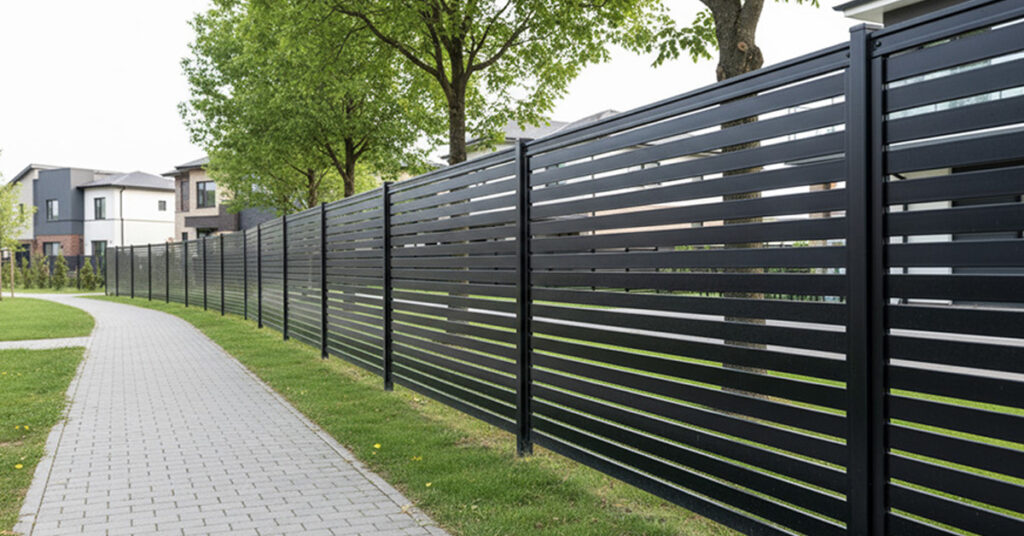
Horizontal semi-privacy fencing in an engineered steel frame is the right choice when long-term durability and modern aesthetics matter as much as the screening function. It installs cleanly, requires no ongoing maintenance, and holds its appearance for decades.
Get a Quote for Your Semi-Privacy Fence
FenceTrac ships semi-privacy fencing nationally and has been supplying contractors, property owners, and commercial buyers since 2012.
Every system carries a 20-year warranty and is engineered for long-term performance with minimal maintenance.