
You can often replace a dumpster enclosure without replacing the concrete pad, but the new enclosure still has to meet today’s code.
We’d start with four checks: screening height, gate opening, material rules, and truck access.
Then we’d verify whether the existing slab and bollards can stay, and whether posts should be cored or surface-mounted.
Before ordering, we’d also confirm the fire-separation rule, gate swing path, and hauler clearance, because a layout that fit years ago may fail review now.
Here’s the short version:
- Code comes first. Old site conditions do not override current local rules.
- Pads can often stay. But slab condition, thickness, rebar, and utility conflicts must be checked.
- Bollards matter. If they block gate swing or truck access, the layout may need changes.
- Gate layout is a big deal. A gate that opens on paper can still fail in the field.
- Material choice can be limited. Near some buildings, only certain infill may meet fire-separation rules.
- Hauler input helps. A truck needs room to approach, open, lift, and leave without hitting posts, gates, or walls.
A few numbers stand out.
Commercial double-gate setups commonly come in 8-foot and 12-foot widths, and some rolling or cantilever options can reach up to 32 feet for larger openings.
The main point is simple: check the ordinance, inspect the site, get approval, then order.
If we skip that order, we risk buying an enclosure that does not pass review or does not work on pickup day.
What the replacement enclosure has to satisfy now
A replacement enclosure has to pass today’s review, not the rules that applied when the original pad went in.
So start with the items reviewers usually check first.
Height, gates, material, and hauler access
Screening height comes first.
Check how tall a dumpster enclosure needs to be before you order.
Gates need to close all the way and block the opening when shut.
Double gates with a commercial drop rod can help keep both leaves in place between pickups.
Once the opening works, the next thing to check is whether the existing pad can stay.
Material rules may be different now, especially near an occupied building.
See whether fire-rated fence is required around a dumpster enclosure before you pick the infill.
Hauler access also has to work in the field, not just on a site plan.
The truck needs enough room to reach and service the container without hitting gates, posts, bollards, or the building.
Confirm the final layout with your waste hauler before you order.
Rules change from one jurisdiction to another, so check current ordinance and permit needs with your planning department before you move ahead.
If the layout works on paper, the next step is to see what the existing pad and bollards can support.
sbb-itb-908b3eb
How to decide whether the existing pad and bollards can stay
Start with a site inspection.
Measure the slab, bollards, and clearances before you order replacement materials.
That record is what a reviewer needs to decide if the pad and bollards can stay.
What to document before submitting the replacement layout
A reviewer will want more than a sketch.
Bring measured site notes, photos of the slab and bollards, setback data, and the proposed gate swing direction.
You should also verify the exact dimensions of the current dumpster and any dumpster that may replace it with your hauler.
That includes the lid height when fully open, so the enclosure still provides full screening when the dumpster is serviced.
Check the bollard locations too.
They need to stay outside the gate swing and they can’t block hauler access.
If the bollards sit in the wrong spot, the reviewer may ask for changes.
Reuse is not automatic, even if the slab and bollards still look usable.
Check setbacks from the building and property lines, and make sure the enclosure location still meets current zoning placement rules.
If the slab can stay, the next step is simple.
Figure out whether the posts can be mounted without coring.
When the slab cannot be cored
If utilities or reinforcement block coring, use surface-mounted base plates on the existing slab.
See whether FenceTrac offers surface-mount base plates for details on what that installation requires.
Before you choose a mounting method, confirm slab thickness, reinforcement layout, and anchor-bolt pull-out strength.
| Factor | Core-Mounted Posts | Surface-Mounted Base Plates |
|---|---|---|
| What must be verified | Slab depth, rebar location, underground utilities | Slab integrity, thickness, anchor bolt pull-out strength |
| Best fit | New pads or situations requiring deep structural stability | Existing pads where coring is restricted or undesirable |
| Impact on existing slab | Higher risk of hitting rebar or utility lines during coring | Preserves slab integrity; no buried footings required |
Choosing gates and materials that hold up in daily service
Once the pad and mounting set are done, the next big call is the gate layout and infill.
That’s what decides whether the replacement enclosure works smoothly in day-to-day service, or becomes a headache.
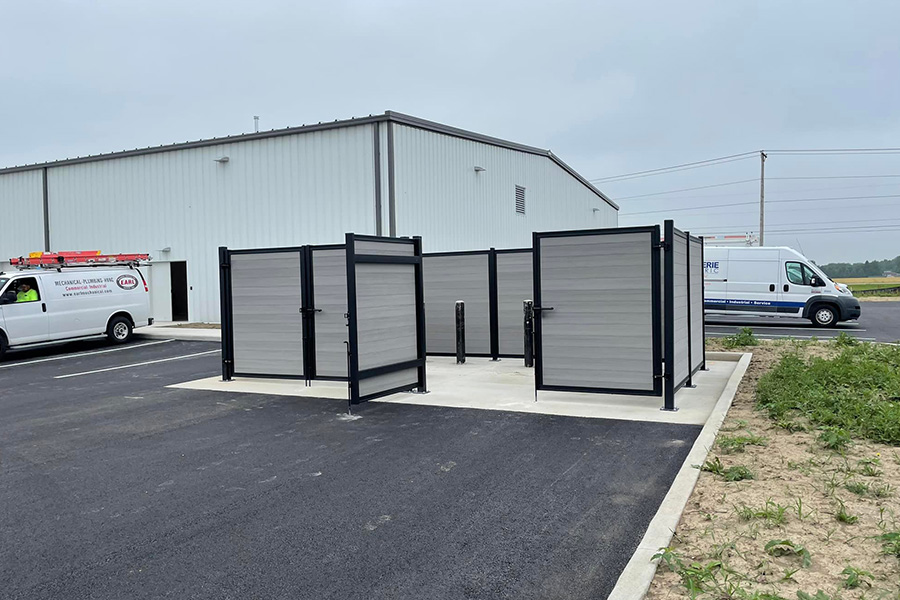
See how FenceTrac can be used for dumpster corral enclosures for configuration details, and visit FenceTrac enclosures for the full product range.
Double gates, drop rod, and swing clearance the hauler can use
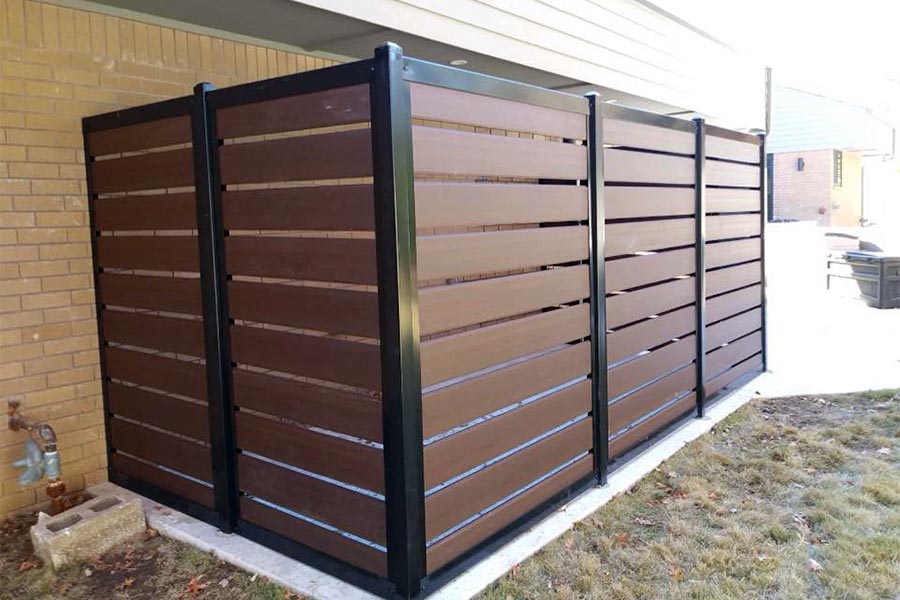
Commercial dumpster enclosures are available with double gates in 8-foot and 12-foot widths.
FenceTrac aluminum gate kits in both double configurations include a drop rod that pins the stationary leaf to the ground while the active leaf opens, which helps keep the opening steady during service.
Before fabrication, map the full swing arc on the site plan.
That step matters more than it sounds.
The gate leaves need to clear bollards, parked vehicles, and nearby building walls at every point in the swing.
Hinge placement and swing direction should be locked in before fabrication, not after.
If the opening is nonstandard, or the job calls for a tougher setup, FenceTrac also offers custom welded steel gates, cantilever gates, and rolling gates for commercial projects, including automated options up to a 32-foot opening.
When fire-rated infill applies and how to match the building
If the enclosure sits close to a combustible wall or building opening, the qualifying fire-rated configuration on the FenceTrac system is aluminum infill on the galvanized steel frame.
Confirm the needed setback with your building department, since local amendments vary.
If a fire-rated setup is not required, the choice shifts to two things, how well the infill holds up and how it looks with the rest of the site.
The table below covers the main options available on the FenceTrac dumpster enclosure fencing system.
| Infill | Type | Fire-Rated |
|---|---|---|
| Aluminum | Metal board | Yes |
| LuxeCore (aluminum-core composite) | Composite board | No |
| UltraBlend (PVC) | PVC board | No |
| Cedar | Wood board | No |
| OmniView (welded wire) | Welded wire | No |
After code-driven material choices, match the finish to the building.
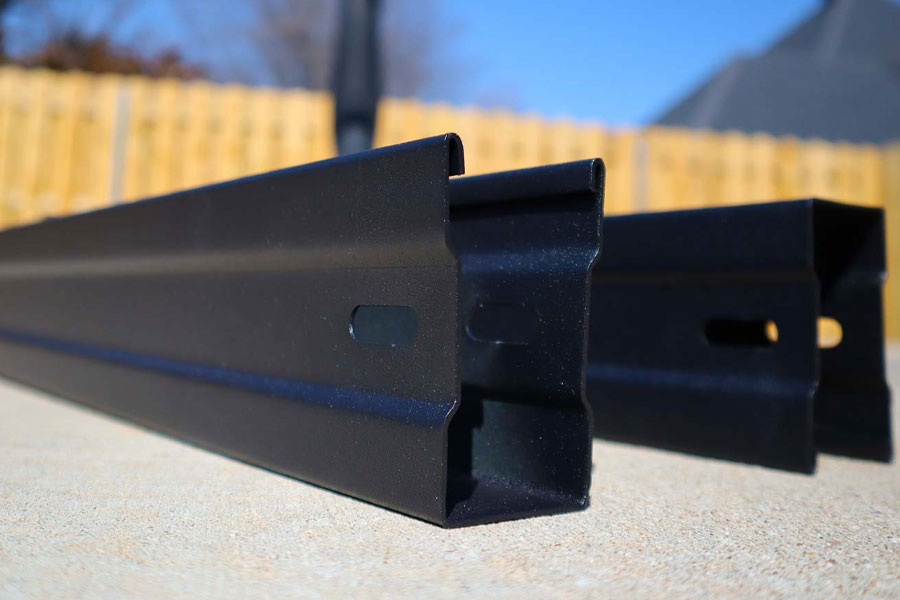
The FenceTrac frame is finished on both sides, and the frame powder-coat color can be selected so the enclosure looks intentional on the property.
For a full look at enclosure configurations, see FenceTrac enclosures.
Confirm the ordinance, check the site, then order the replacement enclosure
You’re replacing an enclosure on an existing pad, so the job is usually meeting today’s ordinance without rebuilding the slab.
Once the height, gate, material, and pad details are settled, move through approval and ordering in that order.
Start with the code.
Confirm the 5-foot screening height requirement with FenceTrac’s dumpster enclosure height guide.
Then check whether the site calls for a fire-rated material with FenceTrac’s fire-rated enclosure guide.
Do this before you measure or order anything.
It also helps to have the hauler review the proposed layout before fabrication, so gate width and truck approach are confirmed up front.
Inspect the pad and bollards.
Check that the concrete pad is stable.
Make sure bollard placement protects the new frame without blocking the gate swing path.
Then settle the post-mounting method, whether that’s surface-mount base plates or another method that fits the existing slab.
Once the site is documented, the layout is ready for review.
Submit, get approval, then order.
Send the replacement layout to your building department for sign-off.
After approval comes through, review FenceTrac dumpster enclosure fencing [8].
Then use the FenceTrac pricing page [9][10] to request pricing for the frame, posts, infill, and gates as one package.
FAQs
Can I keep my existing concrete pad?
Usually, yes, as long as the new enclosure still meets current rules for screening, gates, materials, and hauler access.
In many cases, you can keep the existing pad and bollards without rebuilding them.
That said, it’s smart to confirm the exact rules with your building department, HOA, and the FenceTrac team.
What if the gate works on paper but not on pickup day?
A gate can look fine on paper and still fail on pickup day.
If the hauler can’t get wide, unobstructed access, or the gates don’t have enough swing clearance, the enclosure still has a problem.
The gate needs to open far enough for safe dumpster service, without tight turns, blocked panels, or awkward maneuvering.
In most cases, that means double gates sized to match the hauler’s approach and how the truck operates on site.
The hard part is this: a gate that meets a drawing doesn’t always work in the field.
Before you sign off, confirm the clear opening and gate swing with your waste hauler.
When is fire-rated infill required?
You’ll usually run into this when your city requires non-combustible or fire-rated materials, often for enclosures placed near occupied buildings.
The catch is that the exact rule can change from one jurisdiction to the next.
If you’re replacing a dumpster enclosure, check the fire-rated material rules, screening height, gate layout, and hauler clearance with your building department, HOA, and the FenceTrac team.
Related Blog Posts
- Solving the ‘Ugly Dumpster’ Problem: Aesthetic Screening for Commercial Sites
- Graffiti, Vandalism, and Fast Panel Repair for Commercial Properties
- Commercial Fence Repair or Replacement: The Decision Framework Property Managers Use
- Zoning Says Opaque Screening: What Commercial Owners Have to Build to Pass Plan Review