
FenceTrac’s modular steel frame system builds a fence that looks identical on both sides as a standard feature of every panel. The galvanized steel U-channels grip the infill boards from all four edges, hiding the structural connections and producing a symmetrical, finished face on both the owner’s side and the neighbor’s side of the fence.
The Short Answer
Use a fence system that holds the infill inside the frame rather than attaching it to one face of the frame. FenceTrac’s U-channel design does this by default. The infill boards slide into steel channels, and the finished panel shows only the flat infill surface and the narrow powder-coated steel edge from both directions. No exposed rails. No visible fastener heads on the panel face.

Why Traditional Fences Only Look Good on One Side
A conventional wood privacy fence attaches vertical pickets to horizontal rails using nails or screws. The rails run between the posts on one side of the fence. From the picket side, the fence looks clean. From the rail side, you see the back of the pickets, the horizontal rails, and the full face of each post.
Some builders attempt to fix this by adding a second layer of pickets on the opposite side (a “shadowbox” or “board-on-board” design). This uses twice the lumber, adds weight to the structure, and still leaves the horizontal rails visible between the boards. It improves the appearance but does not truly make both sides identical.

How the FenceTrac Frame Creates a Both-Sided Fence
FenceTrac’s approach is fundamentally different from post-and-rail construction.
The U-Channel System
The frame consists of steel channels shaped like a U. The top channel, bottom channel, and two side channels form a rectangular frame around each panel. The open side of each U faces inward, creating a track that accepts the infill boards.
Infill boards slide into the channels from the top and stack vertically (or horizontally, depending on orientation). The channels grip the edges of the boards on all four sides. From either face of the fence, the boards sit flush with the outer edge of the channel, producing the same flat, clean surface.

No Face Fasteners
The infill boards are held in place by the four-sided channel frame, not by nails or screws through the face of the boards. The only visible fasteners are the carriage bolts that connect the top and bottom channels to the side channels, and these sit at the narrow edge of the frame, not on the broad face of the panel.
This means both sides of the fence are smooth, uninterrupted surfaces with no nail heads, screw holes, or bracket shadows.
Symmetrical Frame Profile
The side channels attach to the posts with self-tapping screws on the narrow edge facing the post. The post sits between panels. From either side, you see the infill, the steel channel edge, and the post. The view is the same from both directions.
Best Infill Options for a Both-Sided Fence
Every infill option in the FenceTrac system produces a both-sided result, but some are better suited to specific applications.
| Infill | Both-Sided Appearance | Best For |
|---|---|---|
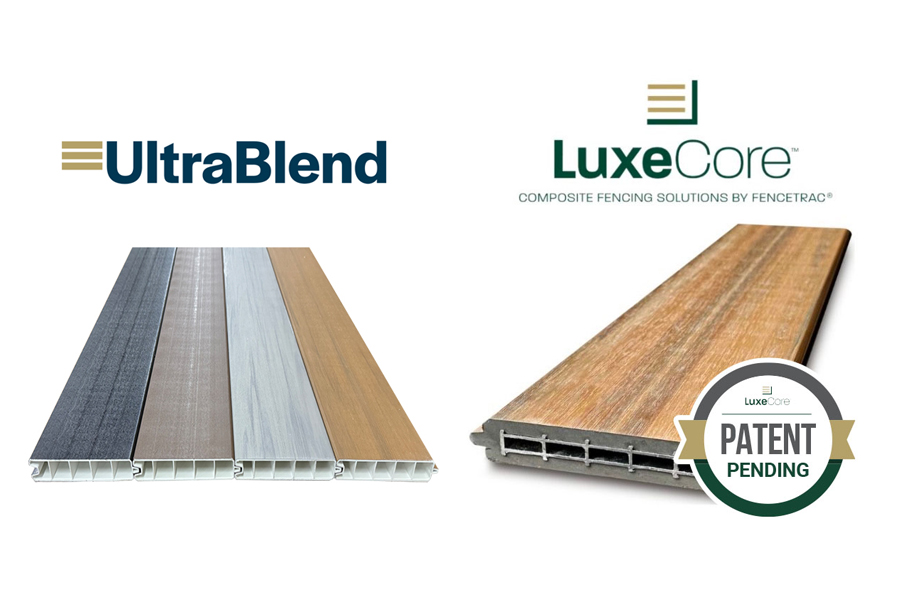
| LuxeCore composite | Identical textured wood-look on both faces | Premium residential, HOA communities |
| UltraBlend PVC | Identical textured wood-look on both faces | Residential, shared property lines |
| Aluminum (tongue and groove) | Identical smooth finish on both faces | Modern, commercial, fire-rated |
| Aluminum (semi-privacy slats) | Identical slat pattern on both faces | Pool areas, front yards, modern design |
| Cedar | Same wood grain visible on both faces | Natural wood aesthetic |
For the most consistent long-term result, LuxeCore composite and UltraBlend PVC are the top choices. Both are maintenance-free, carry a Limited Lifetime Warranty, and hold their color and texture on both faces for the life of the fence.
Design Considerations for Both-Sided Fences
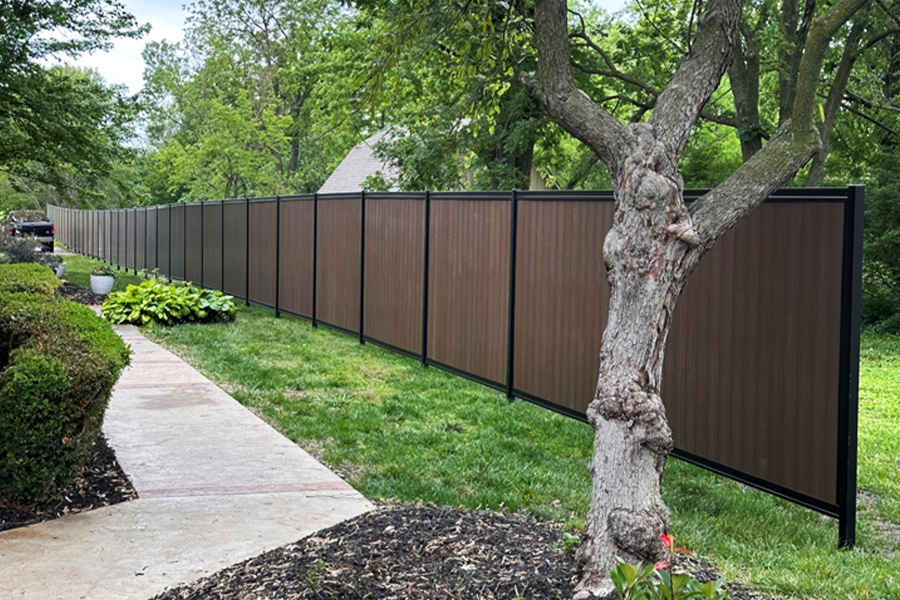
Frame color matters when both sides are visible. Black is the most popular because it recedes visually, letting the infill be the focal point. Bronze pairs well with warm-toned infill (Timber Brown, Tropical Teak). White and Silver suit light-colored architectural styles.
For custom infill patterns like mixed composite and aluminum boards, the pattern is visible identically from both sides. This makes the FenceTrac system a strong fit for design-forward fence projects where the fence is a visual feature, not just a boundary.
Fence Ideas for Shared Boundaries
When building on a shared property line, a both-sided fence eliminates the most common dispute between neighbors. Neither side gets the lesser view. Both homeowners see the same finished panel.
A 6-foot FenceTrac privacy fence with a neutral infill color (Harbor Gray or Timber Brown) and a black frame is the most universally appealing shared-boundary configuration. It satisfies HOA requirements, looks good from both yards, and requires no maintenance from either property owner.
Related Questions
What is a good neighbor fence? A good neighbor fence is any fence that presents the same finished appearance from both sides. FenceTrac is a good neighbor fence by default.
Can I add lattice or trim to both sides of a FenceTrac fence? The system is designed as a complete panel. Adding external trim is not necessary because both sides are already finished. If you want a decorative top accent, the 4-foot height option can be used as a topper above a wall or planter, with the full panel visible from both sides.
See Also
FenceTrac privacy fencing for panel sizes, frame colors, and infill options.
Get a Quote for a Both-Sided Fence
FenceTrac ships fence systems nationally and has been manufacturing engineered fencing in the USA since 2012.
Every system carries a 20-year warranty and is engineered for long-term performance with minimal maintenance.