
FenceTrac’s modular fence system produces rackable fence panels that pivot to follow sloped ground instead of staying level. A rackable panel adjusts its angle during installation so the top and bottom rails run parallel to the grade. FenceTrac panels are rackable up to 30 degrees, which covers the majority of residential and commercial slopes without any modification to the frame components.
The Short Answer
A rackable fence panel is one that can angle to follow a slope. Instead of stepping the fence down a hill with gaps at the bottom of each section, a rackable panel tilts so the fence stays a consistent height above the ground along the entire line. FenceTrac achieves this through its U-channel frame design, which allows the vertical side channels to pivot relative to the horizontal rails.

How Rackable Fence Design Works
On a flat lot, fence panels mount squarely between posts. The side channels sit perpendicular to the top and bottom rails, and everything forms a rectangle.
On a slope, the posts are still set plumb (vertically straight), but the panel between them needs to tilt to follow the ground. A rackable panel handles this by allowing the side channels to change angle relative to the rails. The result is a parallelogram instead of a rectangle.
The FenceTrac U-channel frame makes this possible because the side channels attach to posts with self-tapping screws rather than fixed brackets. The installer positions the side channel at the correct angle, drives the screws, and the panel follows the slope. The infill boards slide into the channels and lock in place with their tongue-and-groove profile.

What Makes a Fence Panel Non-Rackable
Not all fence types can rack. Panels with rigid corner connections, welded joints, or pre-assembled frames that cannot pivot are non-rackable. Common non-rackable fence types include precast concrete panels, some welded aluminum ornamental fencing, and prefabricated vinyl panel systems with fixed corner brackets.
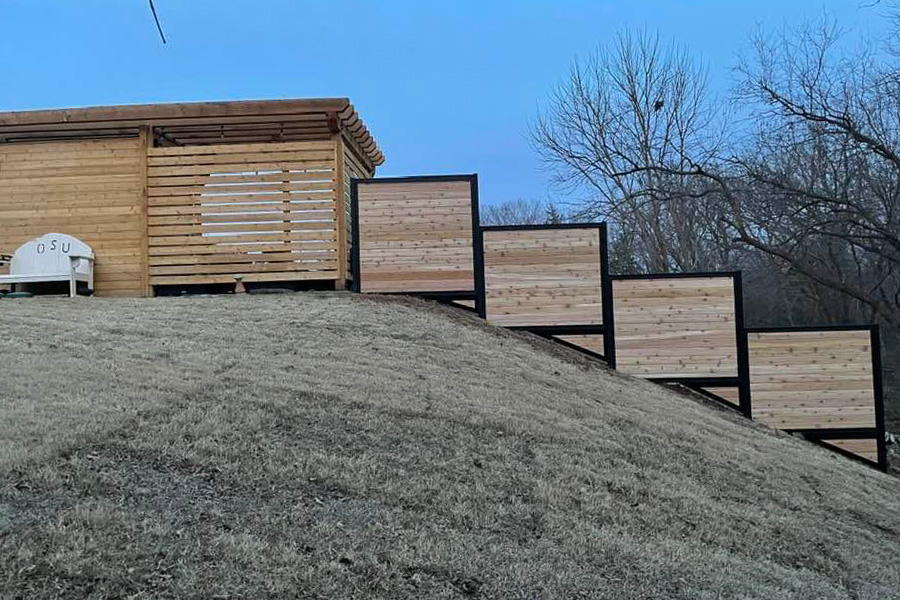
When a non-rackable fence is installed on a slope, the only option is stair-stepping. Each panel stays level, and the fence drops down in uniform steps. This leaves triangular gaps at the base of each step where the ground falls away, which compromises privacy and allows animals or debris to pass under the fence.
Rackable Range: Why 30 Degrees Matters
FenceTrac panels rack up to 30 degrees from level. That covers a wide range of real-world terrain.
A 30-degree slope means the ground drops roughly 7 inches for every 12 inches of horizontal distance. Most residential yards, even those described as “hilly,” fall well within this range. Slopes steeper than 30 degrees are uncommon in developed residential areas and more typical of embankments, retaining wall faces, or undeveloped hillsides.
For slopes beyond 30 degrees, the installer can combine racking with stair-stepping. The racked sections follow the moderate grade, and stepped sections handle the steeper drops. The same FenceTrac posts and hardware work for both approaches.
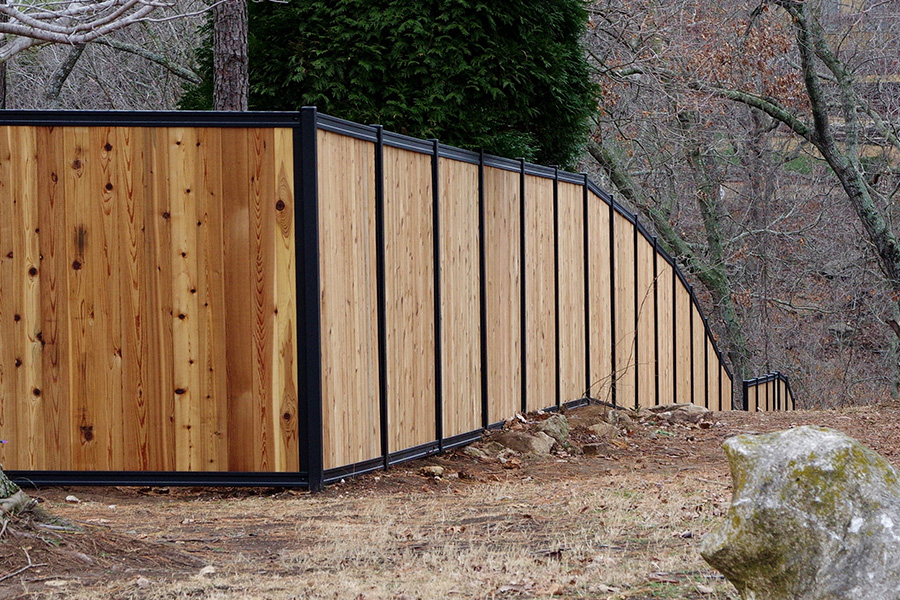
Benefits of Rackable Panels for Fence Ideas on Sloped Lots
Rackable panels offer practical advantages over stair-stepping on sloped properties.
No Gaps at the Base
The fence follows the ground, so there is no open space at the bottom. This is critical for privacy fencing, pet containment, and security applications where a gap defeats the purpose of the fence.
Cleaner Appearance
A racked fence line looks intentional and finished. Stair-stepped fences can look choppy on gradual slopes where the steps are visible but small. Racking produces a smooth line that follows the natural contour of the property.
Less Site Work
Stair-stepped fences on moderate slopes often require fill dirt, retaining walls, or additional infill to close the gaps at the base. Rackable panels eliminate this extra work because the fence conforms to the existing grade.
Related Questions
Can you install FenceTrac on a slope? Yes. FenceTrac panels rack up to 30 degrees to follow sloped terrain. For steeper grades, stair-stepping or terracing is used.
What infill options work with the FenceTrac modular frame? The FenceTrac frame accepts LuxeCore aluminum-core composite, UltraBlend PVC, aluminum, cedar, and other rigid infill up to 1 inch thick. All infill types work with racked panels.
How do you build an extremely strong privacy fence? Start with a galvanized G90 steel frame and powder-coated posts. The FenceTrac system combines structural strength with design flexibility, including racking for sloped installations.
See Also
FenceTrac specifications for engineering details on racking range, panel dimensions, and post sizing. Watch assembly videos for a visual walkthrough of the installation process on flat and sloped terrain.
Get a Quote for Your Fence Project
FenceTrac ships fence systems nationally and has been manufacturing engineered fencing in the USA since 2012.
Every system carries a 20-year warranty and is engineered for long-term performance with minimal maintenance.