
A dog fence works when it stops four escape points: over, through, under, and out the gate.
We can boil this down to a simple checklist: use enough height, keep gaps tight, keep the bottom close to the ground, and make sure the gate shuts and latches every time.
If we want numbers to start with, a 4-foot fence can work for many small dogs, 6 feet fits most large dogs, and 8 feet is often the safer pick for dogs that jump or climb. For spacing, 2 inches or less suits small dogs, and 3 inches or less fits many medium and large dogs.
Here’s the short version:
- Height stops jumping
- Tight spacing stops squeezing through
- Low ground clearance slows digging
- Self-closing, self-latching gates stop easy escapes
- Solid panels can help dogs that bark or pace at movement
- Rackable panels help on slopes by cutting gaps at the base
The hard part is not just choosing a fence that looks good.
It’s picking one that still works after a dog leans on it, paws at it, digs by it, or tests the gate day after day.
| Fence factor | Good starting point | Why it matters |
|---|---|---|
| Height | 4 ft., 6 ft., or 8 ft. | Helps stop jumping and climbing |
| Side spacing | 2 in. for small dogs, 3 in. for many larger dogs | Helps stop squeeze-through and head entrapment |
| Bottom gap | 1 to 2 in. on flat ground | Helps stop crawling under |
| Dig guard | 12 to 18 in. buried mesh | Helps in digging hot spots |
| Gate gap | Under 3 in. | Helps stop side escapes |
| Gate hardware | Self-closing hinges, self-latching latch | Helps keep the gate shut |
In other words, if you get those few parts right, you cover most of the risk without overthinking the build.
1. Choose fence height based on your dog’s size and escape history
Pick fence height based on your dog’s size, jumping ability, and past escape attempts.
Height sets the limit, but spacing and hardware finish the job.
Spend a few days watching how your dog works the fence line.
Look for jump tries, pacing, and the spots your dog keeps coming back to.
That tells us more than breed alone.
How to decide between 4-foot, 6-foot, and 8-foot
A 4-foot fence works for small dogs that stay low and don’t try to leap.
A 6-foot fence works for most big dogs and athletic breeds.
An 8-foot fence makes sense for escape artists and dogs that have jumped or climbed before.
Once the fence is tall enough, spacing becomes the next thing that stops an escape.
Move benches, planters, and woodpiles away from the fence.
Those items can turn into little launch pads.
For climbers, solid composite panels work better.
Open mesh can give them footholds.
Then check the bottom edge, because digging is often the next weak spot.
Fence priorities by dog type: comparison table
| Dog Type | Recommended Height | Gap Control | Digging Risk | Infill/Gate Priority |
|---|---|---|---|---|
| Small Breeds (<25 lbs) | 4 ft. | High (<2–3 in.) | Moderate | Tight picket spacing |
| Athletic Jumpers | 6–8 ft. | Moderate | Low | Solid panels; anti-climb |
| Large/Strong Breeds | 6 ft. | Moderate | Moderate | Rigid infill; heavy-duty latches |
| High-Drive/Working Breeds | 7–8 ft. | Moderate | High | Privacy panels; block sightlines |
Once height is set, the next step is tight gap control.

2. Control gaps and sightlines with tight infill spacing
Height stops jumps, spacing stops squeezes.
A gap that looks small to us may still be big enough for a dog.
Gaps can also create head entrapment hazards, where a dog gets through partway but can’t back out.
Dogs that can see movement through the fence often pace and bark along the fence line.
Block that view, and you remove a common trigger.
Once the sides are tight, the next weak spot is the bottom edge.
Set spacing so dogs cannot squeeze through or use gaps as footholds
Set gaps for your smallest dog.
For dogs under 20 lbs, keep vertical gaps at 2 inches or less.
For medium and large dogs, 3 inches or less is a solid limit.
For escape artists or highly reactive dogs, solid panels with no planned gap are the right call.
Exposed rails can turn into footholds.
When boards are face-nailed onto exposed rails, a determined dog may use those rails to climb.
FenceTrac privacy systems deal with that by placing infill boards inside recessed steel U-channels.
That leaves a smooth face on both sides, with nothing to grab.
The same idea matters at the ground line, where dogs look for room to dig.
Semi-privacy fencing gives homeowners a middle ground if they want airflow without giving up containment.
FenceTrac‘s stackable spacer clips start at ¾ inch, with added 1-inch increments, so you can set the gap to match your dog’s size.
For a full look at board and slat choices, visit the infill options page.
For dogs that bark at movement, tongue-and-groove infill, like LuxeCore composite or UltraBlend PVC, fits boards tightly together with no gaps.
That creates a solid visual barrier at dog eye level.
Video: H-clip slat spacing for better gap control
The video below shows how H-clips work inside FenceTrac’s frame system to keep slats at even, adjustable distances:
Because the slats sit inside the steel frame instead of being nailed to exposed rails, they keep their spacing over time.
They also support a semi-private slat fence that still limits what a dog can see.
With side gaps under control, the next step is closing the ground gap.

3. Close the ground gap and pick materials that hold up to dogs
Next, close the ground gap.
Lower the ground gap and discourage digging
On flat ground, keep the bottom rail 1 to 2 inches above the soil.
On slopes, use rackable panels so the fence follows the grade without leaving gaps at the base.
FenceTrac frames rack up to 30 degrees, which fits most residential slopes cleanly.
If your dog likes to dig, add a buried barrier at the base.
A good setup is 12 to 18 inches of welded wire mesh buried in an L-shape, especially at corners, gate ends, and shaded spots.
You can also add a 12- to 18-inch-wide strip of large river rock to make digging a lot harder.
Once the bottom edge is locked down, the next thing to watch is the infill.
Pick rigid infill for large dogs and daily wear
Even if the fence handles gaps and slopes well, it can still fail if the infill bends under leaning, pawing, or jumping.
That’s why rigid options like LuxeCore composite and aluminum slats work well for daily wear.
They hold their shape without cracking or bowing.
FenceTrac’s U-channel frame secures infill boards on all four sides, which helps reduce the chance of boards getting pushed loose under pressure.
See the infill options page for compatible materials.
| Infill Material | Best For | Key Advantage |
|---|---|---|
| LuxeCore Composite | Large dogs, high-impact use | Rigid, high-strength, maintenance-free |
| Aluminum Slats | Strength, modern look | Strong, holds shape, non-combustible |
| UltraBlend PVC | Privacy, weather resistance | Maintenance-free; thicker than typical vinyl |
| Tongue & Groove Cedar | Natural look, moderate wear | Traditional appearance; requires staining or sealing over time |
With the base and infill secured, the last weak point is the gate.
sbb-itb-908b3eb
4. Secure the gate and decide when a visible fence makes more sense
Once the bottom edge is locked down, the gate is usually the last weak spot.
That’s where many dogs make their move.
Gate hardware that resists nudging, sagging, or swinging open
Two pieces of hardware matter most: self-closing hinges and self-latching hardware.
Self-closing hinges use spring tension to pull the gate shut if someone leaves it open.
Self-latching hardware locks the gate the moment it swings closed.
Use 3-inch or 4-inch steel gate posts to help keep the latch lined up and cut down on sag.
Check the gap at the bottom and sides of the gate on a regular basis.
Keep the gate-side gap under 3 inches so a dog can’t squeeze through.
For double gates, a drop rod helps lock the fixed panel in place so a large dog can’t shove both sides open at once.
If your dog is an escape artist, a double-gate entry gives you a backup, one gate closes before the second opens.

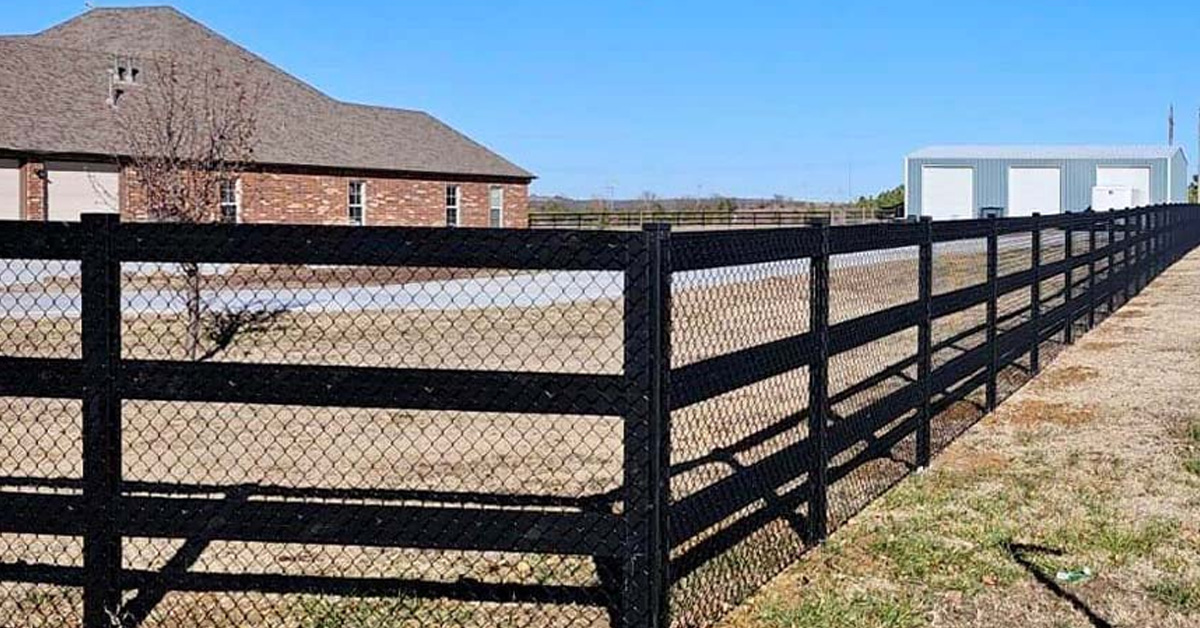
HighPlains with black chain link for open-view containment
If you want visibility and containment, go with a rigid frame and black chain link.
The pet-friendly chain link fence option in the HighPlains system pairs a rigid steel frame with black vinyl-coated chain link.
The black coating cuts glare and helps the fence fade into the landscape.
The steel frame helps keep the fence firm.
Use 9-gauge chain link for medium and large dogs.
The HighPlains frame is also rackable, so it can follow sloped ground and help cut down on gaps at the base on uneven terrain.
This setup works well for front yards, large properties, or any yard where supervision, airflow, and visibility matter more than privacy.
But the basics stay the same: a firm frame, a tight ground gap, and a secure latch.
Conclusion: Build your dog fence around height, gap control, grade, and gate security
After all the details, the rule is still simple.
A dog fence that works comes down to four things: enough height, tight spacing, low ground clearance, and a secure gate.
Get those four right, and your dog is far more likely to stay where it should.
That same logic shapes the FenceTrac options below.
FenceTrac gives you three containment styles: solid privacy, controlled-gap semi-privacy, or open-view chain link.
You can use FenceTrac’s adjustable infill spacing and rackable panels to fit your yard, even when the grade isn’t flat.
Price My Fence to start your fence design.
FAQs
How do I choose the right fence height for my dog?
Choose fence height based on your dog’s size, breed, and athletic ability.
- Under 25 pounds: 3 feet minimum, 4 feet is a safer pick
- 25 to 50 pounds: 4 to 5 feet
- 50 to 80 pounds: 5 feet minimum, 6 feet is a better bet
- Athletic or extra-large breeds: at least 6 feet, and some strong jumpers may need 7 to 8 feet
Size matters, but it’s not the whole story.
A lean, high-energy dog can clear a fence that seems tall enough on paper.
That’s why it helps to look at your dog’s jumping habits and overall energy level before you decide.
What is the safest gap size for a dog fence?
For a safe, secure dog fence, keep all gaps under 3 inches at the bottom, along the sides, and between double gates.
Dogs can slip through spaces that look too small to matter.
Use tightly butted infill or tongue-and-groove boards to close those openings.
If you want a semi-privacy design, stackable spacers can help keep the gaps narrow enough that your dog can’t get through.
How can I stop my dog from digging under the fence?
Use rackable fence panels that follow your property’s grade.
They move with the slope, so the fence stays close to the ground.
That matters because stair-stepped panels can leave triangular gaps along the bottom on hills and uneven spots.
Those gaps can turn into easy escape routes.
If your yard is especially uneven, you may also need fill dirt or terracing to close any gaps that are left.