
FenceTrac’s modular fence system builds each panel inside a four-sided galvanized G90 steel, powder-coated frame that holds rigid infill boards from all four edges. Traditional fencing nails or screws individual boards to one face of a horizontal rail. The structural difference affects strength, appearance, longevity, and maintenance for the life of the fence.
The Short Answer
A modular fence system assembles pre-engineered components into self-contained panels. The FenceTrac frame uses 3-inch deep horizontal channels and 2-inch deep side channels to grip infill material from every edge, creating a panel with no face fasteners and a finished appearance on both sides.
Traditional fencing attaches boards to one side of a rail with nails or screws. The boards act independently, the fasteners bear all the load, and the back side of the fence shows exposed rails and fastener points.
How Traditional Fence Construction Works
Traditional fencing follows a familiar sequence. Posts go into the ground. Horizontal rails span between posts, usually two or three per section. Individual boards are nailed or screwed to the front face of the rails, standing side by side vertically.
Each board is held in place only by its fasteners. No structural connection exists between adjacent boards. If a nail loosens or a board warps, that board separates while the rest of the fence stays intact.
The method is straightforward and uses widely available lumber. But it creates inherent weaknesses that show up over time.
Fastener-Dependent Strength
Every board is only as strong as the nails or screws holding it to the rail. Wood expands and contracts with moisture and temperature shifts. This cycle loosens fasteners progressively, creating rattling boards, widening gaps, and boards that eventually fall off.
One-Sided Appearance
Boards attach to one face of the rails, so the opposite side shows exposed 2×4 rails, nail points, and the unfinished back of each board. Property owners on the “bad side” see the structural skeleton instead of a finished fence.
This is why both-sided fencing has become a priority for buyers who share a fence line with neighbors.
Limited Material Compatibility
Traditional rail construction was designed around dimensional lumber. Using non-wood infill like composite or PVC with a post-and-rail frame requires specialty fasteners, pre-drilling, and added blocking to prevent cracking and flexing. The method works best with wood and struggles with everything else.
How a Modular Fence System Works
FenceTrac’s modular approach replaces the post-and-rail method with a channel frame system. Four steel channels, one top, one bottom, and one on each side, form a rectangular frame. The open face of each channel points inward, creating a continuous track around the inside perimeter.
Infill boards slide into the channels and stack inside the frame. When the panel is fully loaded and the top channel is secured, every board is held by channel contact pressure on all four edges. No nails or screws penetrate the infill surface.
The side channels attach to galvanized, powder-coated steel posts with self-tapping screws. Carriage bolts connect the horizontal and vertical channels at the corners. The result is a rigid, fully enclosed panel that transfers wind and impact force through the steel frame into the posts.
Design Differences That Matter Over Time
The structural gap between the two methods compounds with age. Here is how the two approaches compare on the factors that determine long-term fence performance.
| Factor | Modular (FenceTrac) | Traditional Post-and-Rail |
|---|---|---|
| Frame material | Galvanized G90 steel, powder-coated | Dimensional lumber (pine, fir, or cedar) |
| Board attachment | Channel grip on all 4 edges, no face fasteners | Nails or screws through face of board |
| Finished sides | Both sides identical | One finished side, one exposed |
| Compatible infill | Any rigid material up to 1″ thick | Primarily dimensional lumber |
| Wind load tested | 55.0 psf design load (ASTM E330) | No standardized test exists |
| Frame warranty | 20-year warranty | Most wood fences carry no frame warranty |
| Maintenance | None on frame; depends on infill choice | Annual staining/sealing for wood |
The wind load data is significant. FenceTrac’s system was tested to 55.0 psf design wind load and 82.5 psf structural load at QAI Laboratories under ASTM E330. Traditional wood fencing has no comparable standardized test because the construction method varies too widely to produce repeatable results.
Which Method Fits Which Application
Traditional post-and-rail still works for short-term perimeter fencing where appearance and long-term durability are not priorities. Temporary construction barriers, rural property markers, and budget installations expected to last 5 to 10 years are reasonable applications for traditional construction.
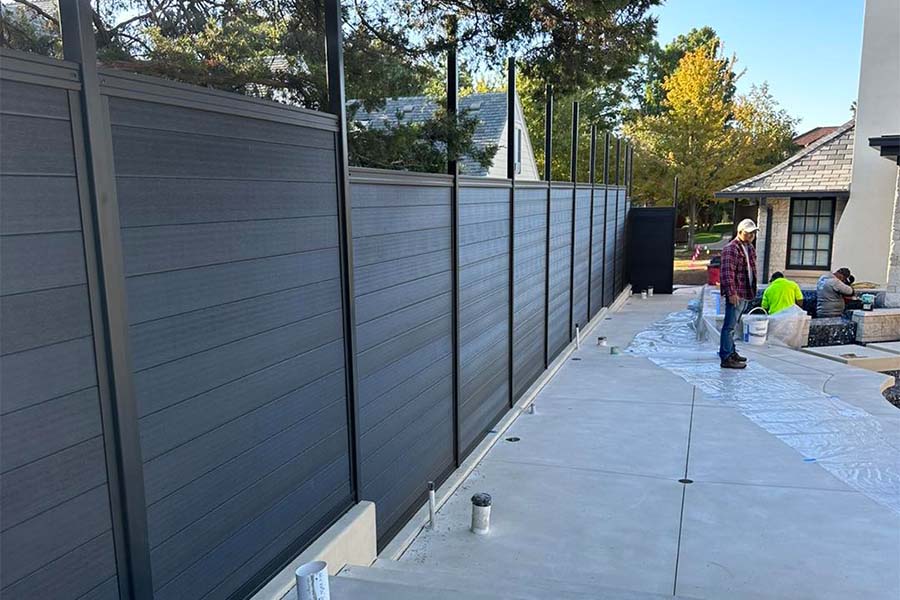
Modular fence systems are the stronger choice when the fence needs to last, look professional on both sides, resist wind loads, or accept non-wood infill materials like composite, PVC, or aluminum. Residential privacy fencing, commercial property perimeters, pool enclosures, and any fence that represents the property’s public appearance benefit from a modular system.
The range of infill materials the modular frame accepts also opens up fence design options that traditional construction cannot match. Composite, PVC, aluminum, decorative metal, and dozens of other rigid materials fit the same FenceTrac frame without specialized fastening.
Related Questions
Is it better to build from scratch or buy a fence kit? Modular fence kits like FenceTrac arrive with pre-cut, pre-drilled components. The assembly process is faster and more consistent than cutting and assembling raw lumber on site.
Is a steel frame fence more expensive upfront but cheaper long-term? The upfront cost of a modular steel frame system is higher than wood post-and-rail. Over 15 to 20 years, the total cost of ownership favors the modular system because maintenance, repair, and replacement costs are near zero.
See Also
FenceTrac privacy fencing for system details, and channel frame modular fencing explained for a deeper look at how the U-channel design works.
Get a Quote for Your Modular Fence Project
FenceTrac ships fence systems nationally and has been manufacturing engineered fencing in the USA since 2012.
Every system carries a 20-year warranty and is engineered for long-term performance with minimal maintenance.