
FenceTrac’s fire-rated fencing system carries an ASTM E84-24 Class A fire rating with a Flame Spread Index of 0 and a Smoke Developed Index of 35, tested by QAI Laboratories. The building codes that trigger fire-rated fencing requirements are the International Building Code (IBC), NFPA 101 Life Safety Code, and the jurisdiction-specific amendments that local building departments adopt on top of these model codes.
The Short Answer
Three code frameworks drive fire-rated fencing requirements in the United States. The IBC covers construction standards for commercial and multi-family buildings, including separation barriers near occupied structures. NFPA codes address life safety and fire prevention in specific facility types. Local jurisdictions adopt one or both of these model codes and frequently add their own amendments that tighten requirements for fencing near structures, equipment, and property lines.
No single national code says “you must install fire-rated fencing.” The requirement comes from the interaction between the building type, the proximity of the fence to occupied structures, the materials in the fence, and the local authority having jurisdiction (AHJ).
International Building Code (IBC)
The IBC is the most widely adopted building code in the United States. Most states and municipalities use the IBC as their baseline, with local amendments layered on top.
Chapter 8: Interior Finishes (Section 803)
IBC Chapter 8 regulates the fire performance of interior finish materials by referencing ASTM E84 test results. While this chapter is written for interior applications, many AHJs extend these requirements to exterior structures that are within a specified distance of an occupied building. When they do, any fence or screening wall within that distance must meet the same flame spread and smoke development limits that interior finishes require.
FenceTrac’s aluminum infill meets ASTM E84-24 Class A with a Flame Spread Index of 0, the lowest possible result. This satisfies the most restrictive Class A requirement (Flame Spread Index 0-25, Smoke Developed Index 0-450) with significant margin.

Chapter 7: Fire-Resistance-Rated Construction
IBC Chapter 7 addresses fire barriers, fire partitions, and fire-separation distances between buildings or between a building and a property line. When a fence or screening structure falls within the fire-separation distance, the AHJ may require it to be constructed of non-combustible materials or materials with a tested fire-performance rating.
The aluminum infill used in FenceTrac fire-rated fencing is inherently non-combustible. The fire performance comes from the material composition itself, not from a chemical treatment or coating that could degrade over time.

NFPA Fire Codes
The National Fire Protection Association publishes codes that many jurisdictions adopt alongside or in place of IBC provisions.
NFPA 101: Life Safety Code
NFPA 101 covers egress, fire protection, and life safety in buildings and structures. It references ASTM E84 for surface-burning characteristics of building materials. FenceTrac’s fire-rated fencing meets the NFPA Class A classification under the same test standard (ASTM E84-24), which NFPA 101 recognizes as equivalent to IBC Class A.
NFPA 1: Fire Code
NFPA 1 is a broad fire prevention code that addresses outdoor storage, separation distances, and fire-safety requirements for equipment and structures adjacent to buildings. Jurisdictions that adopt NFPA 1 may require non-combustible fencing or screening near fuel storage, electrical equipment, waste containers, and other fire hazards located outside the building envelope.
Local Amendments and AHJ Requirements
Model codes set the floor. Local jurisdictions regularly exceed it.
California, for example, enforces the California Building Code (CBC), which incorporates IBC provisions with additional requirements for wildfire-prone areas under the Wildland-Urban Interface (WUI) code. Properties in designated WUI zones may be required to use non-combustible or ignition-resistant materials for any fence or structure within a specified distance of the building.
Texas, Florida, and other states with high commercial construction volume have their own amendment packages. Municipal fire marshals in cities like Houston, Phoenix, and Las Vegas frequently require fire-rated materials for screening near transformers, generators, and dumpsters, even when the base code does not explicitly mandate it.
The authority having jurisdiction (AHJ) is the local official who interprets and enforces the code. The AHJ’s interpretation determines whether a specific fence installation requires a fire rating. Always confirm requirements with the local building department before specifying materials.
When the Code Triggers Fire-Rated Fencing
Fire-rated fencing requirements typically arise in these situations.
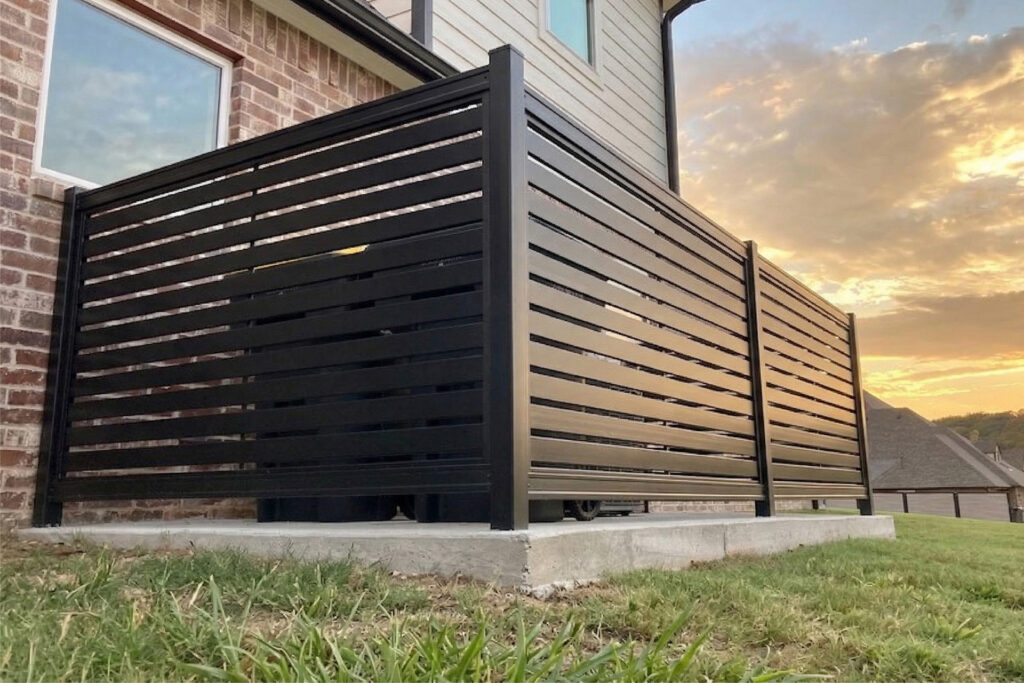
Fencing within the fire-separation distance of an occupied building. Screening around electrical transformers, generators, or fuel storage. Enclosures for dumpsters and waste containers near buildings. Perimeter fencing at schools, hospitals, and healthcare facilities. Fencing adjacent to property lines where the adjoining lot has an occupied structure. Industrial facilities where local fire codes mandate non-combustible barriers.
In every case, the requirement comes from the local AHJ applying the adopted code to the specific site conditions. The same fence that requires no fire rating in one jurisdiction may require Class A performance five miles away under a different AHJ.
How FenceTrac Meets the Requirement
FenceTrac fire-rated fencing uses 6063-T5 aluminum infill boards in a galvanized G90 steel, powder-coated frame. QAI Laboratories tested the system to ASTM E84-24 and recorded a Flame Spread Index of 0 and a Smoke Developed Index of 35. Both numbers are well within the Class A limits (FSI 0-25, SDI 0-450).
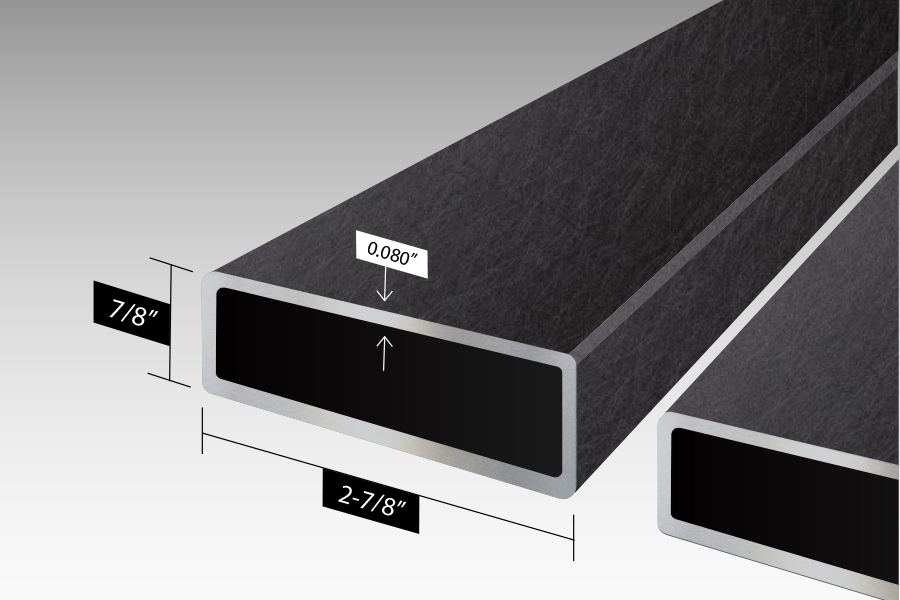
The Flame Spread Index of 0 means zero flame propagation across the surface during the full 10-minute test at ceiling exposure, the worst-case orientation. The aluminum composition drives this result. It is not a coating or treatment that degrades over time.
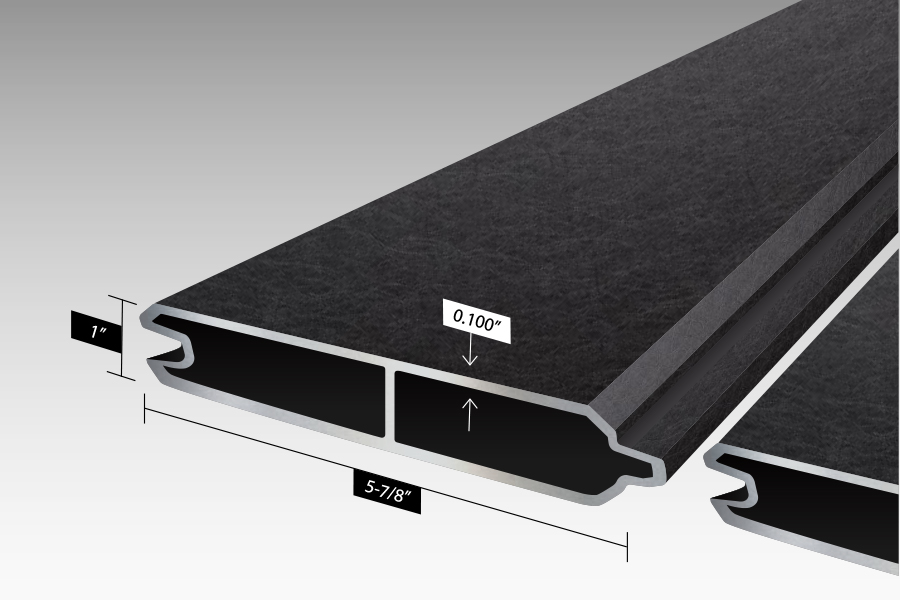
For projects that need both fire rating and high-wind performance, the same steel frame system has been tested to 55.0 psf design wind load under ASTM E330 at QAI Laboratories. Fire compliance and structural performance are not mutually exclusive in this system.
Related Questions
Where is fire-rated fencing most commonly required in the US? Fire-rated fencing requirements cluster around commercial construction zones, wildfire-prone regions, and municipalities with aggressive fire prevention codes. Certain states and metro areas enforce stricter requirements than the base IBC.
What is fire-rated fencing and when is it required? Fire-rated fencing is fencing constructed from materials that meet a tested fire-performance standard, typically ASTM E84 Class A. It is required when local codes mandate non-combustible or fire-rated barriers near occupied structures, equipment, or property lines.
See Also
FenceTrac fire-rated fencing for product details and specifications. Architect specifications for project documentation and bid packages.
Get a Quote for Fire-Rated Fencing
FenceTrac ships fence systems nationally and has been manufacturing engineered fencing in the USA since 2012.
Every system carries a 20-year warranty and is engineered for long-term performance with minimal maintenance.