
Industrial facilities operate under a stricter set of fencing requirements than commercial or residential properties. The perimeter fence at a manufacturing plant, warehouse campus, or data center has to meet security standards, comply with fire codes, handle the structural demands of open-site wind exposure, and in many cases pass third-party inspection during facility certification.
FenceTrac builds fence systems that meet industrial specifications, including the only ASTM E84-24 Class A fire-rated fence configuration available from a modular panel manufacturer.
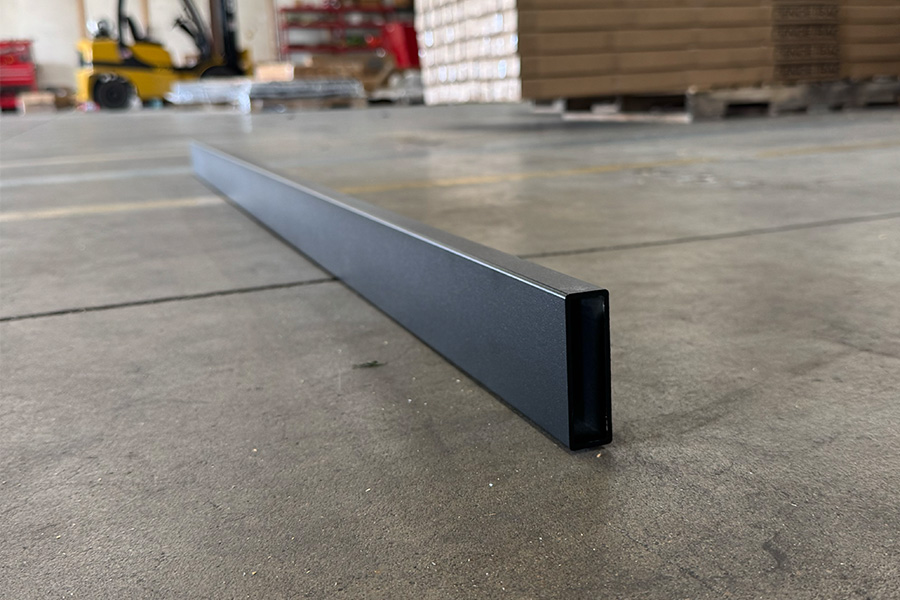
Security Perimeter Fencing for Industrial Facilities
A credible industrial perimeter fence does more than mark the property line. It deters unauthorized access, defines a clear security boundary for monitoring, and provides the physical barrier that insurance carriers and certification bodies require.
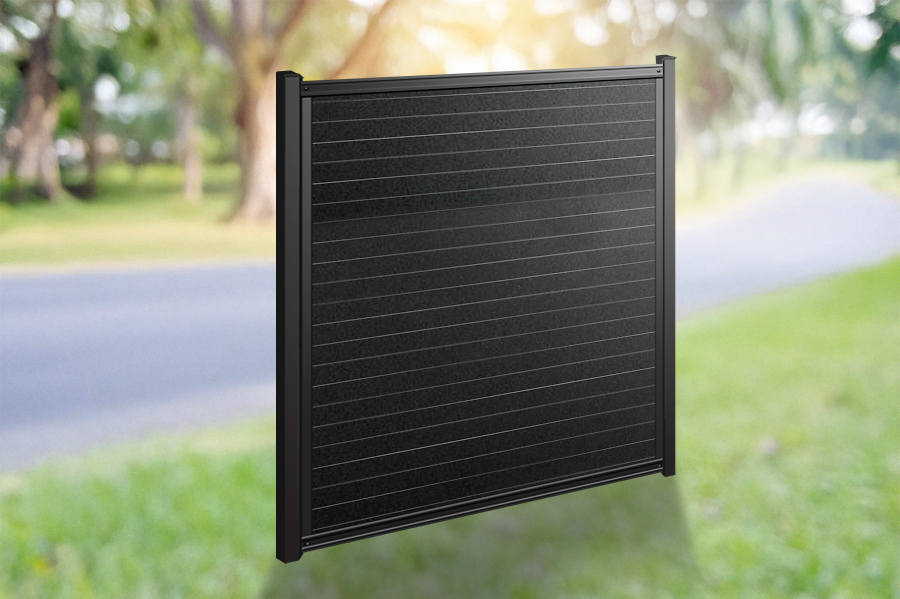
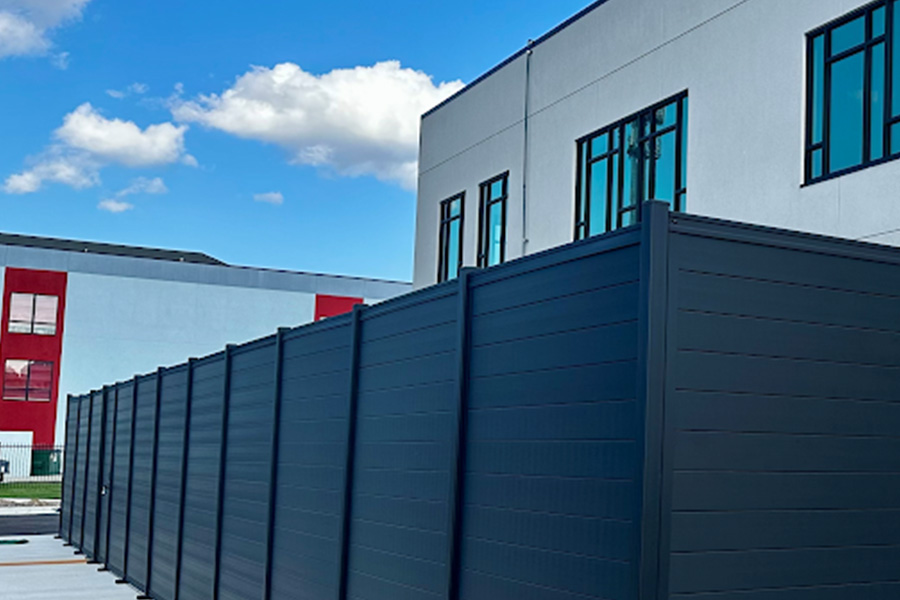
FenceTrac privacy fencing blocks sightlines into the facility from adjacent roads and properties. This matters for sites handling sensitive materials, proprietary equipment, or processes that the operator wants to keep out of public view. The galvanized G90 steel frame and solid infill create a rigid barrier that does not flex or bend under lateral pressure.
OmniView welded wire fencing is the right choice when security cameras and guards need visibility through the perimeter. The welded wire fits inside the FenceTrac frame with brackets, maintaining the structural rigidity of the frame system while providing clear sightlines for security monitoring. The welded construction resists cutting and climbing better than chain link of equivalent gauge.
Combining privacy and welded wire sections along different areas of the same perimeter is common on industrial sites. Privacy fencing screens the front boundary facing public roads, while OmniView provides security monitoring visibility along the back and side perimeters.

ASTM E84-24 Class A Fire-Rated Fencing
Industrial facilities with proximity to occupied structures, flammable material storage, or specific occupancy classifications may require fire-rated fencing as part of their building code compliance.
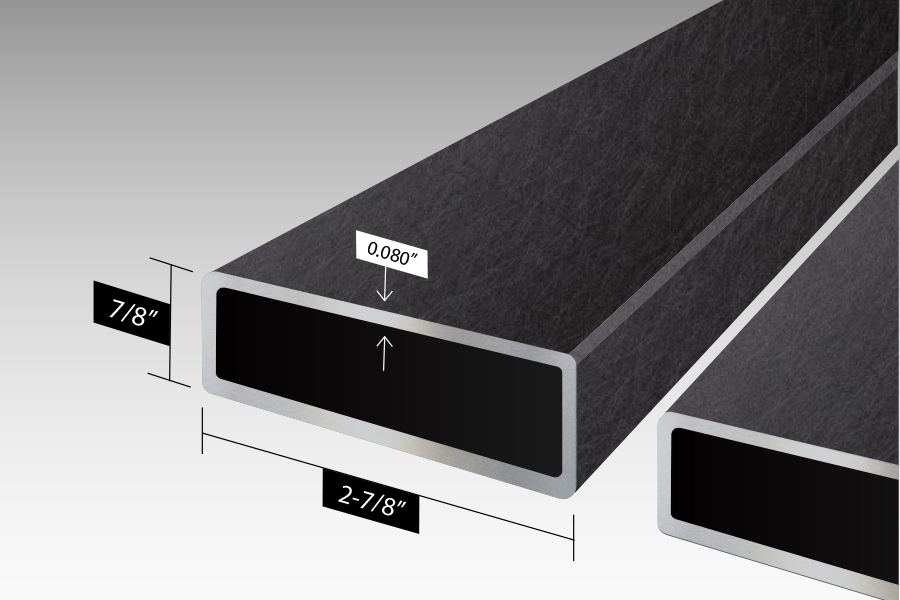
FenceTrac fire-rated fencing meets ASTM E84-24 Class A fire rating standards using aluminum infill boards within the galvanized steel frame. This is a specification that very few fence systems on the market can meet.
Fire-rated fencing is typically required by the local fire marshal or building department when the fence sits within a defined distance of an occupied structure, fire lane, or flammable storage area. Having a fire-rated fence option available from a modular manufacturer eliminates the need for custom fabrication or field-assembled solutions that may not carry a recognized fire rating.
Wind Load Engineering for Industrial Perimeter Fencing
Industrial sites are often located in exposed areas on the edge of developed zones, where there is less shelter from wind than buildings in dense urban or suburban locations. Open yard operations, tank farms, and utility installations face even greater exposure.
FenceTrac systems are engineered to meet commercial and industrial wind load requirements. Standard commercial posts are 3″ x 3″ galvanized G60 steel, with 4″ x 4″ posts available for high wind-load applications. Footing depth defaults to approximately 38″ but is determined by the project Engineer of Record based on local conditions.
For facilities where the fence specification is reviewed by a structural engineer or requires stamped documentation, our guide to high-wind fence engineering covers load calculations, post embedment requirements, and the documentation that industrial fence submittals typically require. Site-specific engineering and stamped drawings are available when the project requires them.
Enclosures for Equipment, Utilities, and Dumpsters
Beyond the perimeter, industrial facilities need enclosed areas for dumpsters, generators, HVAC equipment, utility meters, and other site infrastructure that needs to be screened from view or physically secured.
The FenceTrac Enclosures system uses the same galvanized steel frame with heavy-duty posts. Standard gate options include 4′ or 6′ single gates and 8′ or 12′ double gates for equipment access. Custom steel welded gates are available for non-standard openings.
For industrial facilities, the ability to use the same fence system for both the perimeter and the interior enclosures means consistent specification across the entire site. Replacement parts for any section of the fence, including gates, come from the same manufacturer.
Consistent Specification Across Large Industrial Sites
Industrial facility perimeters are long. A single warehouse campus may require thousands of linear feet of fencing. Consistency matters because maintenance crews need to be able to replace any section with parts that match the original specification.
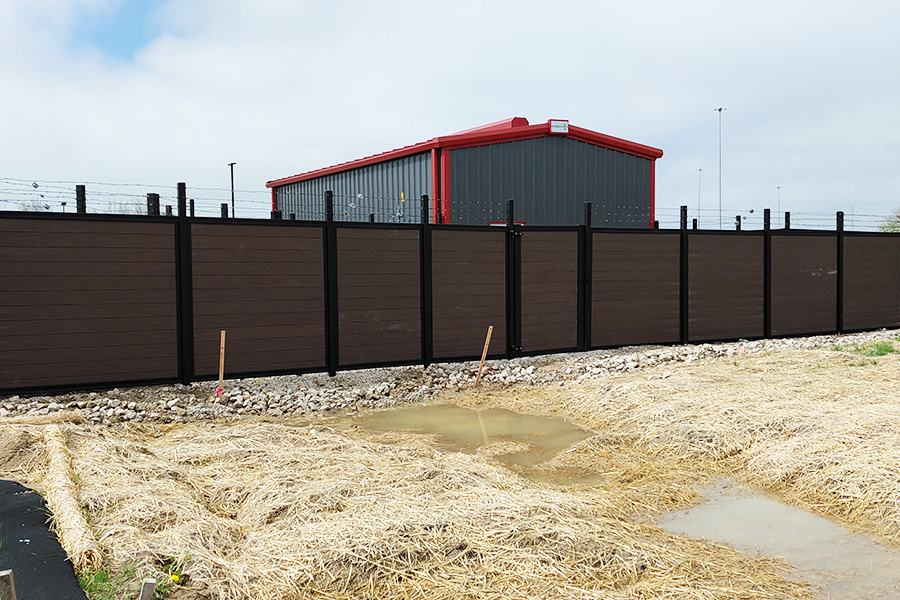
The modular FenceTrac system delivers consistent quality across the entire perimeter. Panel widths of 6′ or 8′ and heights of 4′, 6′, or 8′ cover the range of industrial applications from short equipment screening to full-height security perimeters.
FenceTrac ships nationally, which makes it practical to source a large industrial perimeter from a single manufacturer regardless of the facility’s location. Powder coat color options (Black, Bronze, White, Silver) are consistent across all panel sizes and configurations.
Gate Options for Industrial Access Control
Industrial gate requirements go beyond standard residential hardware. Standard aluminum gate kits work for pedestrian access points, but vehicle access often requires wider configurations.
Double gates in 8′ or 12′ widths accommodate trucks and equipment. Rolling, sliding, and cantilever gate systems are available for commercial and industrial access points where a swinging gate is impractical. Commercial double gates include a drop rod, and all gates use stainless steel hinges and lockable latches as standard hardware.

Get a Quote for Your Industrial Fencing Project
FenceTrac ships fence systems nationally and has been supplying facility managers, contractors, and industrial operators since 2012.
Every system carries a 20-year warranty and is engineered for long-term performance with minimal maintenance.