
FenceTrac’s enclosure system screens HVAC equipment from public view while preserving the airflow clearance that condensers and heat exchangers require to operate efficiently. The system is available in privacy (solid infill), semi-privacy (spaced aluminum slats), and fire-rated (aluminum infill with ASTM E84-24 Class A rating) configurations, all built on the same galvanized G90 steel frame with a 20-year warranty.
The Short Answer
Screen HVAC units with a fence or enclosure that is tall enough to hide the equipment, set back far enough to maintain manufacturer-required airflow clearance, and built from materials that can handle the heat, moisture, and vibration the equipment produces. FenceTrac enclosures meet all three requirements with a modular steel frame that accepts multiple infill types, so you can match the screening to the specific equipment and code requirements on your property.
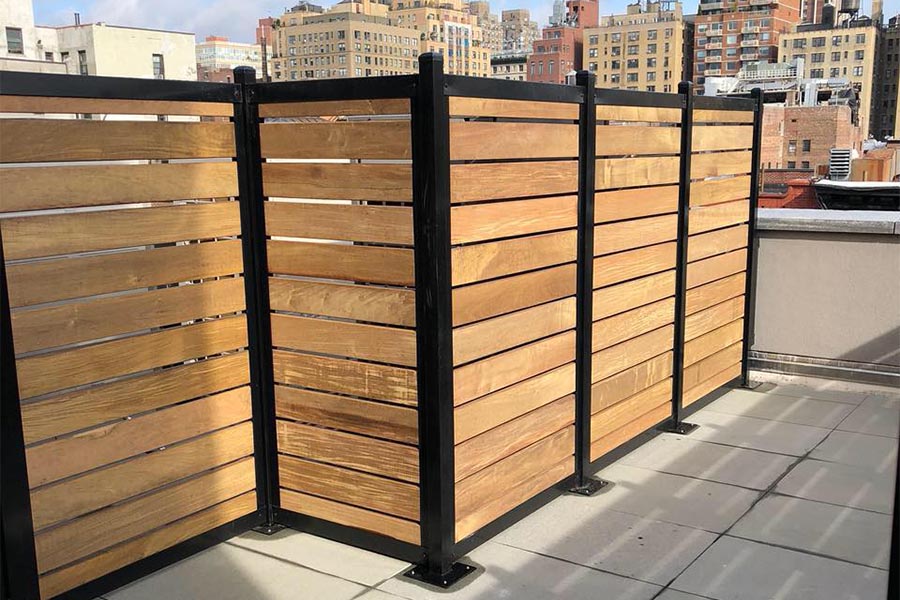
Why HVAC Screening Is Different from Standard Fencing
HVAC equipment has operating requirements that standard perimeter fencing does not need to accommodate. Getting the screening wrong can reduce equipment efficiency, void the HVAC manufacturer’s warranty, or create a fire code violation.
Airflow Clearance
Air-cooled condensers pull air through the coils to reject heat. If the screening fence blocks airflow, the condenser works harder, consumes more energy, and wears out faster. Most HVAC manufacturers require a minimum clearance of 18 to 36 inches between the unit and any obstruction on the sides, with unrestricted airflow above.
This clearance requirement affects both the enclosure size (it must be larger than the equipment footprint by the required offset on all sides) and the infill type. A fully solid privacy panel directly adjacent to a condenser can restrict airflow. A semi-privacy configuration with aluminum slats and controlled spacing allows air to pass through while still screening the equipment from view.
Heat and Moisture Exposure
HVAC condensers discharge warm, moist air. The screening fence sits in this discharge zone and is exposed to more heat and humidity than a perimeter fence. Wood absorbs this moisture and deteriorates faster. Vinyl warps and discolors in the heat plume. FenceTrac’s steel frame and synthetic infill materials resist both heat and moisture without degrading.
Service Access
HVAC technicians need access to the equipment for maintenance, filter changes, refrigerant service, and emergency repairs. The enclosure must include a gate or removable panel that provides full access to the service side of the unit. FenceTrac enclosures use standard gate kits (4-foot or 6-foot single, 8-foot or 12-foot double) that match the enclosure infill and frame.
Choosing the Right Configuration
The correct screening approach depends on the equipment type, its location on the property, and the applicable codes.
Privacy Screening (Solid Infill)
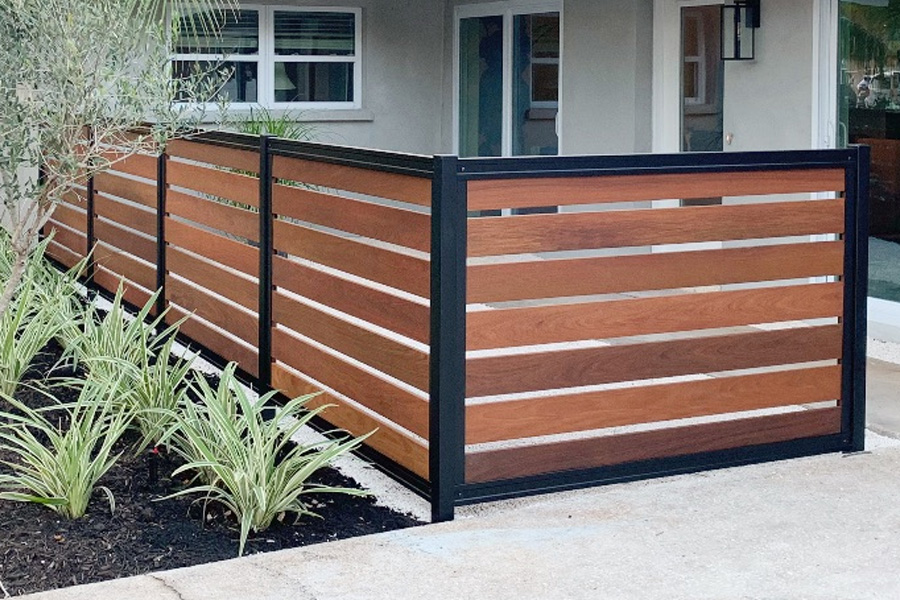
Use solid infill when the enclosure is set back far enough from the equipment to maintain airflow clearance and when full visual screening is the priority. LuxeCore composite or UltraBlend PVC provides a clean, maintenance-free surface in four colors that blends with the building exterior.
Privacy screening works well for ground-level equipment in landscaped areas, equipment pads visible from parking lots or building entries, and residential installations where the homeowner wants the HVAC unit completely hidden.
Semi-Privacy Screening (Spaced Slats)
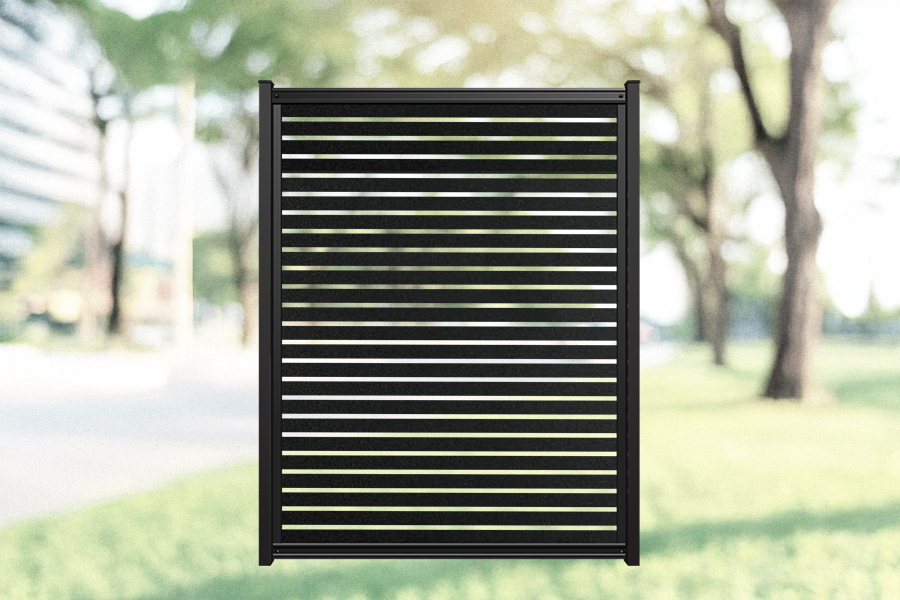
Use semi-privacy when the equipment needs maximum airflow and the code allows partial screening. Aluminum slat boards with FenceTrac-supplied spacers (starting at 3/4 inch, stackable in 1-inch increments) let air pass through while breaking the direct sightline to the equipment.
Semi-privacy screening is the preferred choice for large commercial condensers, rooftop equipment where wind loads require reduced surface area, and any installation where the HVAC manufacturer’s clearance requirements are tight.
Fire-Rated Screening
When the HVAC equipment is near an occupied structure or in a location where fire-rated materials are required by code, FenceTrac’s aluminum infill in a steel frame provides ASTM E84-24 Class A performance. The aluminum boards can be configured as privacy (tongue and groove) or semi-privacy (spaced slats), so fire compliance does not require sacrificing airflow or appearance.

HVAC Screening Design Ideas
Match the HVAC enclosure to the property’s perimeter fence for a unified look. If the perimeter uses FenceTrac with LuxeCore composite in Black Onyx, specify the same infill and color for the HVAC screen. The enclosure becomes part of the landscape, not an afterthought.
For residential properties, a 4-foot FenceTrac enclosure with composite infill screens a standard residential condenser while staying below most HOA height limits for accessory structures.
For commercial properties with multiple HVAC units, use a continuous FenceTrac fence line with integrated gate access at each unit rather than individual standalone enclosures. This approach costs less per linear foot and produces a cleaner architectural line.
Related Questions
What is the best material for a commercial equipment enclosure? The material comparison applies to HVAC enclosures as well. Steel frame with modular infill gives you the most flexibility for equipment that may change over the life of the building.
Can I screen a rooftop HVAC unit with FenceTrac? Yes. Surface-mount base plates attach the enclosure posts directly to the roof deck or concrete pad. The semi-privacy slat configuration is preferred for rooftop installations where wind load and airflow are both factors.
See Also
FenceTrac enclosures for complete product details, gate sizing, and infill options.
Get a Quote for HVAC Screening
FenceTrac ships fence systems nationally and has been manufacturing engineered fencing in the USA since 2012.
Every system carries a 20-year warranty and is engineered for long-term performance with minimal maintenance.