
FenceTrac’s LuxeCore composite infill is a structural board with an aluminum core, cellular PVC layer, and ASA resin exterior that requires zero maintenance over its 20-year warranty period. Wood fencing, by contrast, needs repainting or restaining every 2 to 3 years and typically lasts 10 to 15 years before requiring replacement.
The Short Answer
Composite fencing costs more upfront than wood but eliminates ongoing maintenance costs entirely. Over a 20-year period, the total cost of ownership favors composite because there is no repainting, sealing, board replacement, or pest treatment to budget for.

Composite boards also hold their shape and color far longer than wood. They do not warp, rot, crack, or attract termites.
What Composite Fencing Is Made Of
Not all composite fence boards are the same. Generic composite boards vary widely in core material, surface treatment, and thickness.
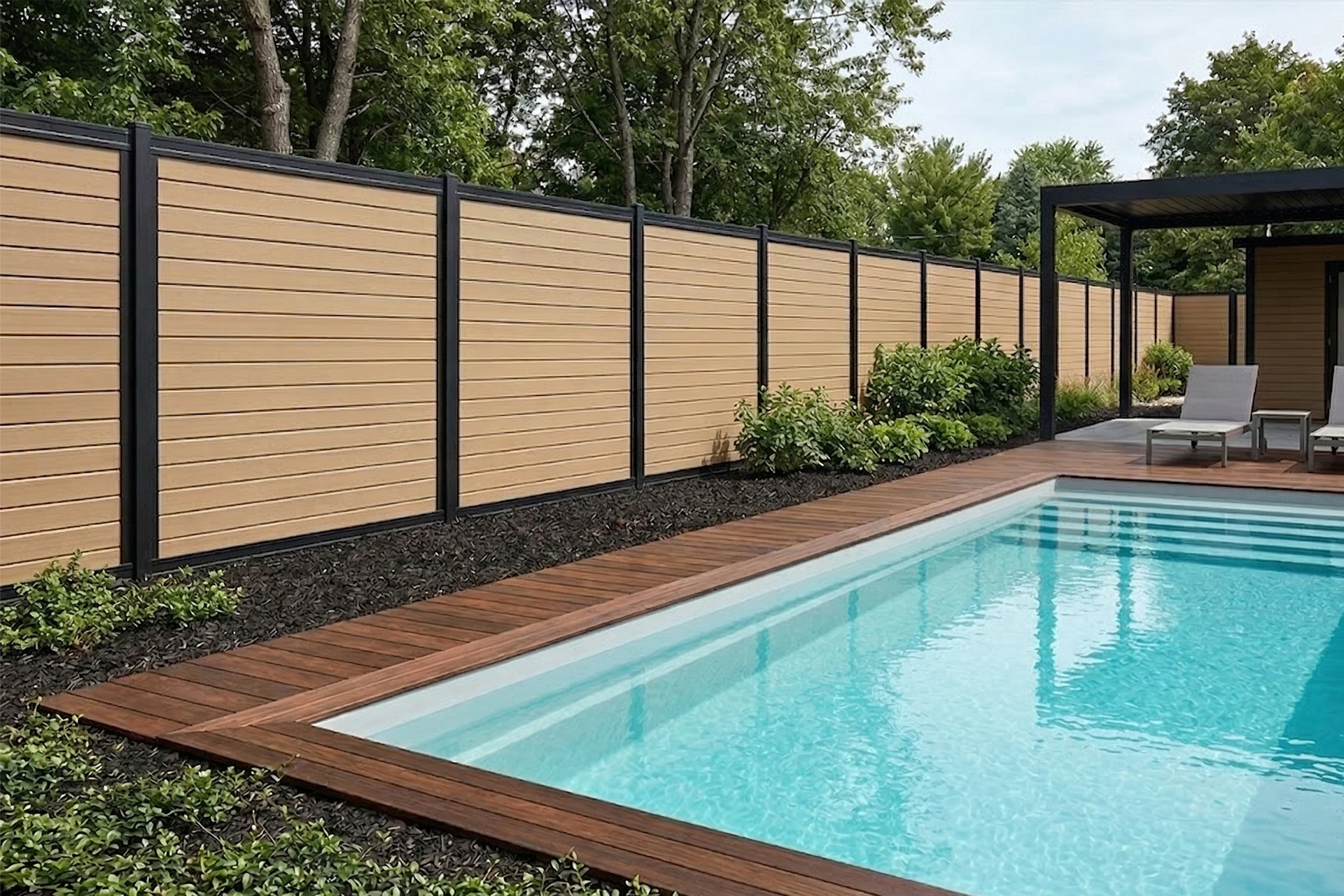
FenceTrac’s LuxeCore composite infill uses a three-layer construction. The structural core is aluminum. That core is wrapped in cellular PVC for rigidity and insulation. The outer layer is ASA resin, a weather-resistant material that provides UV stability, impact resistance, and color retention.
Each LuxeCore board measures 5-7/8 inches wide, 6 feet long, and 1 inch thick with a tongue-and-groove profile. The boards are 100% recyclable.
LuxeCore is available in four colors: Black Onyx, Harbor Gray, Timber Brown, and Tropical Teak. Each has a textured wood-look finish.


What Wood Fencing Is Made Of
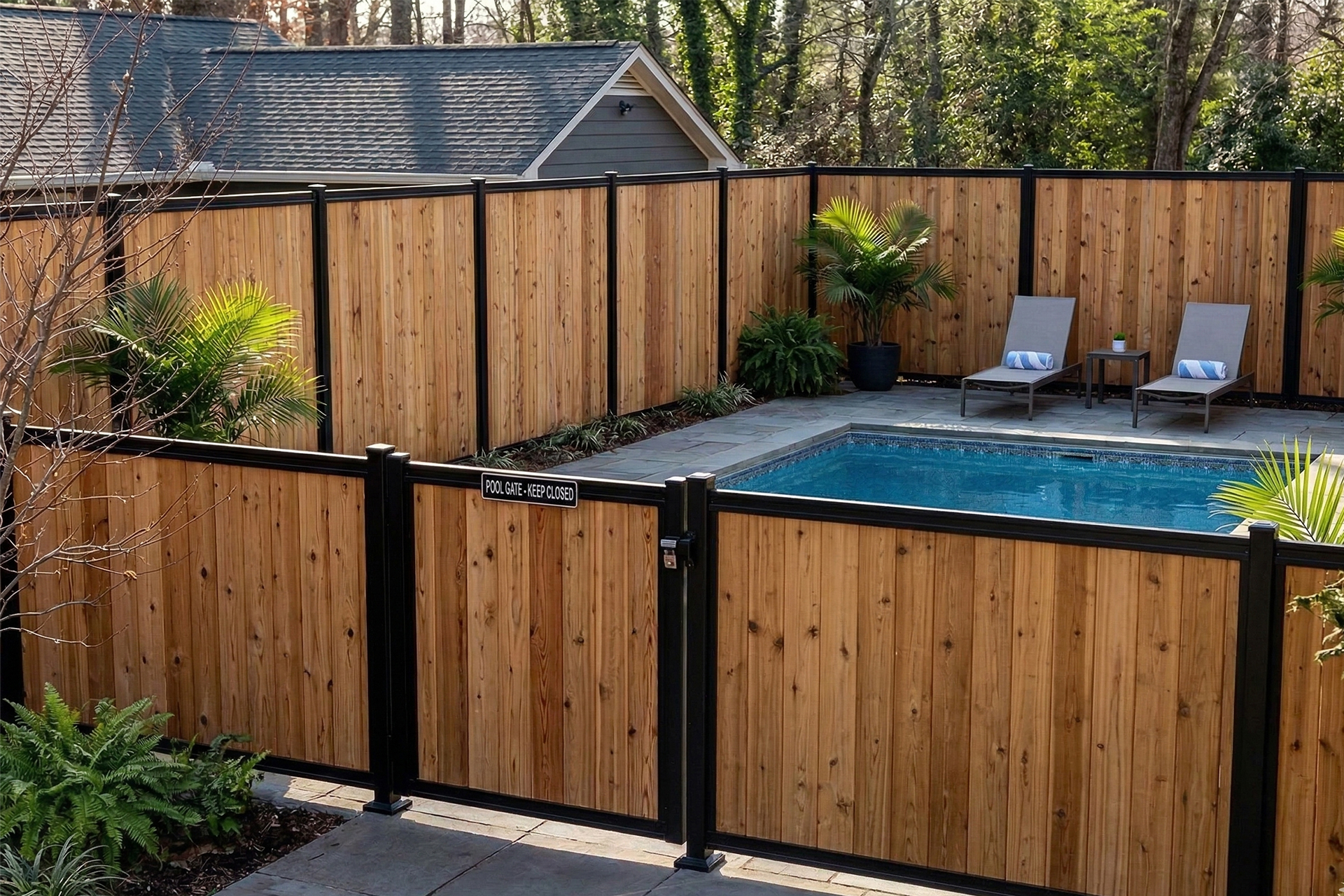
Most residential wood fences use pine, cedar, or redwood. Pine is the most affordable and the most vulnerable to rot and pests. Cedar resists insects better than pine but still absorbs moisture and weathers over time. Redwood is naturally durable but expensive and increasingly difficult to source.

All wood fencing requires a protective finish. Without paint, stain, or sealant, wood begins to gray, crack, and deteriorate within the first year of exposure.
Durability and Weather Resistance
Wood expands and contracts with moisture changes. In climates with heavy rain, snow, or high humidity, this cycle accelerates warping, splitting, and board separation. Fence boards that cup or twist pull away from the rails and create gaps in the fence line.

LuxeCore composite boards do not absorb moisture. The ASA exterior sheds water, and the aluminum core adds structural rigidity that prevents warping and bowing. FenceTrac tested the LuxeCore system to 55.0 psf design wind load and 82.5 psf structural load under ASTM E330 at QAI Laboratories, with no damage to the sample or fasteners.
Wood fencing has no comparable third-party wind load certification.
Maintenance Over Time
Wood fencing requires repainting or restaining every 2 to 3 years. Boards that split or rot need individual replacement. Posts set in soil or concrete degrade at the ground line and often fail before the boards do.

LuxeCore composite infill needs nothing beyond an occasional rinse. No painting. No staining. No sealing. No board replacements.
The FenceTrac frame that holds the composite infill is galvanized G90 steel with a powder-coated finish. The steel frame does not rot, shift, or weaken at the ground line the way wood posts do.
Composite vs. Wood Fencing Comparison
| Factor | LuxeCore Composite | Wood |
|---|---|---|
| Core material | Aluminum + cellular PVC + ASA | Pine, cedar, or redwood |
| Board thickness | 1 inch | Varies (typically 5/8″ to 3/4″) |
| Painting / staining | Never | Every 2-3 years |
| Rot and pest resistance | Immune | Vulnerable (even treated wood) |
| Moisture absorption | None | Yes, causes warping and splitting |
| Wind load tested | 55.0 psf design / 82.5 psf structural (ASTM E330) | No standard certification |
| Warranty | 20 years | Typically none or limited |
| Recyclable | 100% | Varies |
Cost Considerations
Wood fencing has a lower upfront material cost. A standard 6-foot wood privacy fence typically costs less per linear foot than a composite system at the time of purchase.
That gap narrows quickly when maintenance is factored in. Paint, stain, sealant, replacement boards, and labor for repairs add up over the life of a wood fence. Most wood fences need partial or full replacement within 15 years.

A FenceTrac fence with LuxeCore composite infill carries a 20-year warranty and requires zero maintenance investment after installation. For property owners evaluating total cost of ownership rather than just the initial purchase price, composite is the more cost-effective material over time.
Which Is Right for Your Project?
Wood fencing makes sense for short-term installations, projects with tight initial budgets, or situations where the property owner plans to sell within a few years.
Composite fencing in a FenceTrac privacy fence system is the right choice when long-term durability, consistent appearance, and zero ongoing maintenance are priorities. It is especially well-suited for pool environments, coastal properties, HOA communities, and commercial applications where the fence needs to look professional for years without intervention.
For a closer look at the LuxeCore composite infill and its full specifications, visit the LuxeCore product page.
Related Questions
What is the most low-maintenance fence material? Composite and PVC infill boards require zero painting, staining, or sealing. Paired with a galvanized steel frame, the entire system is maintenance-free.
Can composite boards be used in a semi-privacy configuration? The LuxeCore boards are designed for privacy applications inside the FenceTrac frame. For semi-privacy, FenceTrac offers aluminum infill boards with adjustable spacing.
Get a Quote for Composite Fencing
FenceTrac ships composite fence systems nationally and has been supplying contractors, property owners, and commercial buyers since 2012.
Every system carries a 20-year warranty and is engineered for long-term performance with minimal maintenance.